A HOLE PLANET
What if the car was a planet?
I started A Hole Planet while experimenting with a completely different strategy-game concept. I had been building a globe and found something strangely satisfying about moving a camera around a fully rendered planet. That led to a much less serious question: what if the globe was the thing you controlled?
The idea quickly became a five-minute arcade game about a young planet trying to become capable of supporting life by any means necessary. You adjust your orbital radius, speed, and spin to navigate a living solar system—collecting mass, siphoning oceans from neighboring planets, riding through atmospheric clouds, smashing celestial bodies apart, and eventually parking yourself in the habitable zone long enough for life to survive.
The other planets behave like planets. You behave like an asshole.
That contrast became the foundation of the game. The world takes its celestial mechanics seriously enough to feel believable, while the player is given just enough control to completely abuse them. Destroying another planet might give you the mass you need, but its fragments become new obstacles in orbit. Spinning faster repairs your damaged surface, but destabilizes your trajectory. Flying close to the star anneals your planet faster, but boils away the water and atmosphere you just stole.
I conceived the game mechanics, interaction model, visual direction, UI, and system rules, using AI-assisted development to implement the playable browser prototype over a single weekend. The result is a deliberately ridiculous driving game built around a surprisingly serious design problem: how do you make controlling a planet intuitive without making it stop feeling like a planet?
1
Weekend — Idea to Playable Prototype
5 min
Arcade Run
3
Controls — Radius · Speed · Spin
126
Celestial Bodies
1
Goal — Create Life
01 — The Idea
Grand Theft Auto, except the car is a planet.
The concept started as a spoof: take the familiar freedom and destruction of an open-world driving game and put it somewhere driving shouldn’t make any sense.
Instead of a car, the player controls a young planet. Instead of roads, there are orbital paths. And instead of traffic, the environment is filled with planets, moons, asteroids, debris, atmospheric clouds, and a star that can either help repair you or boil away everything you’ve collected.
The objective gives that chaos a purpose. Within five minutes, the player has to transform an unstable planetary body into one capable of supporting life.
The fastest way to get there is usually to ruin somebody else’s solar system.
You start here
Small damaged rocky planet.
You need this
Large habitable planet.
Everything between you and it is fair game.
Five minutes to create life.
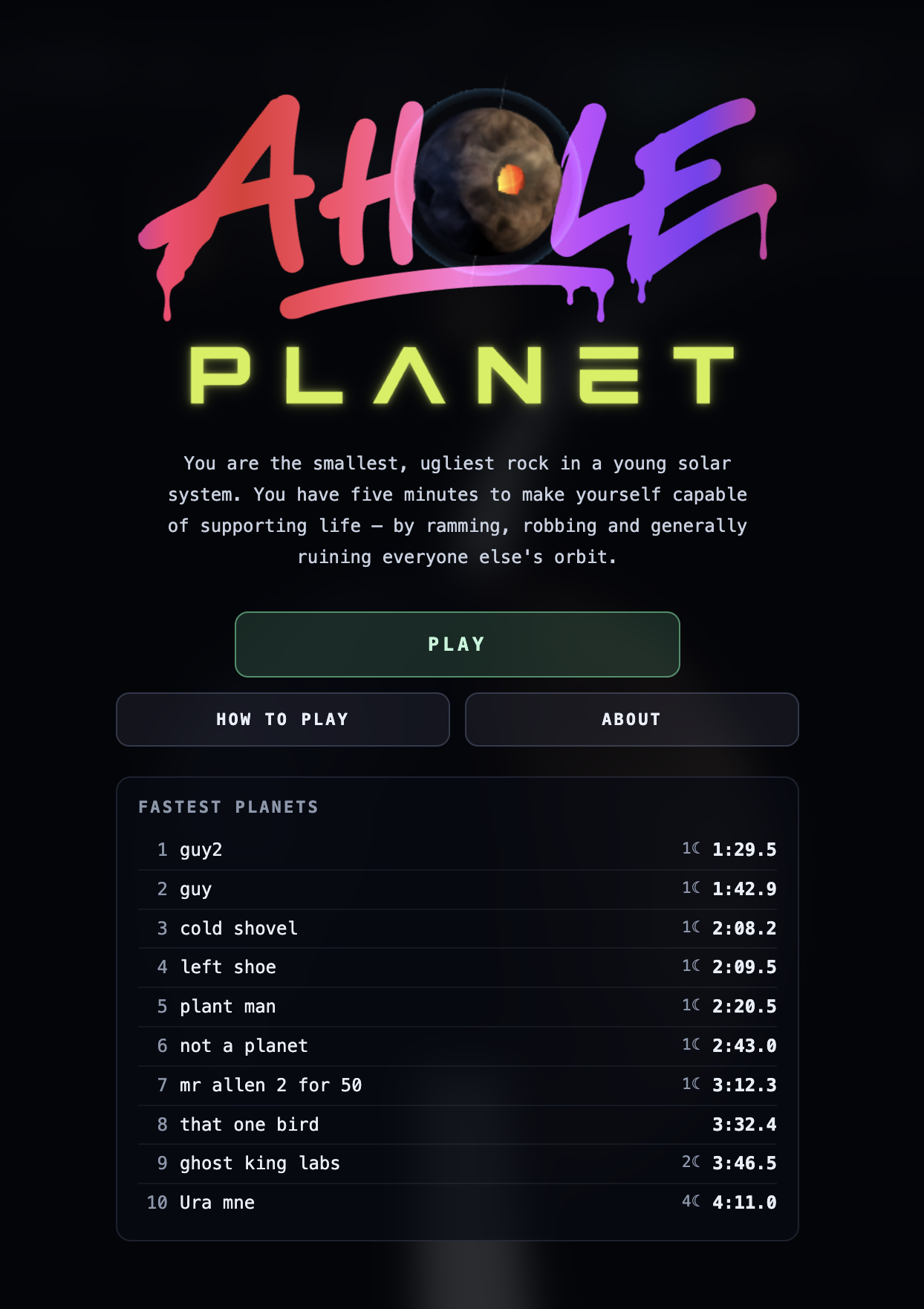
I wanted A Hole Planet to work as a quick arcade game rather than a long simulation. Five minutes creates enough room to build a planet while keeping every decision immediate: there isn’t enough time to patiently wait for ideal conditions, so the player is encouraged to interfere.
A successful run can finish considerably faster. Once the player understands the system, the challenge shifts from simply surviving to finding a more efficient route through it—building mass first, identifying water-rich planets, collecting atmosphere at the right time, minimizing damage, and reaching a stable orbit as quickly as possible.
That naturally turned completion time into the score.
Create life.
Do it faster next time.
The solar system isn’t a racetrack. It’s the material.
I didn’t want the surrounding planets to function as static checkpoints or collectibles. They exist in the same orbital environment as the player and can be physically disrupted.
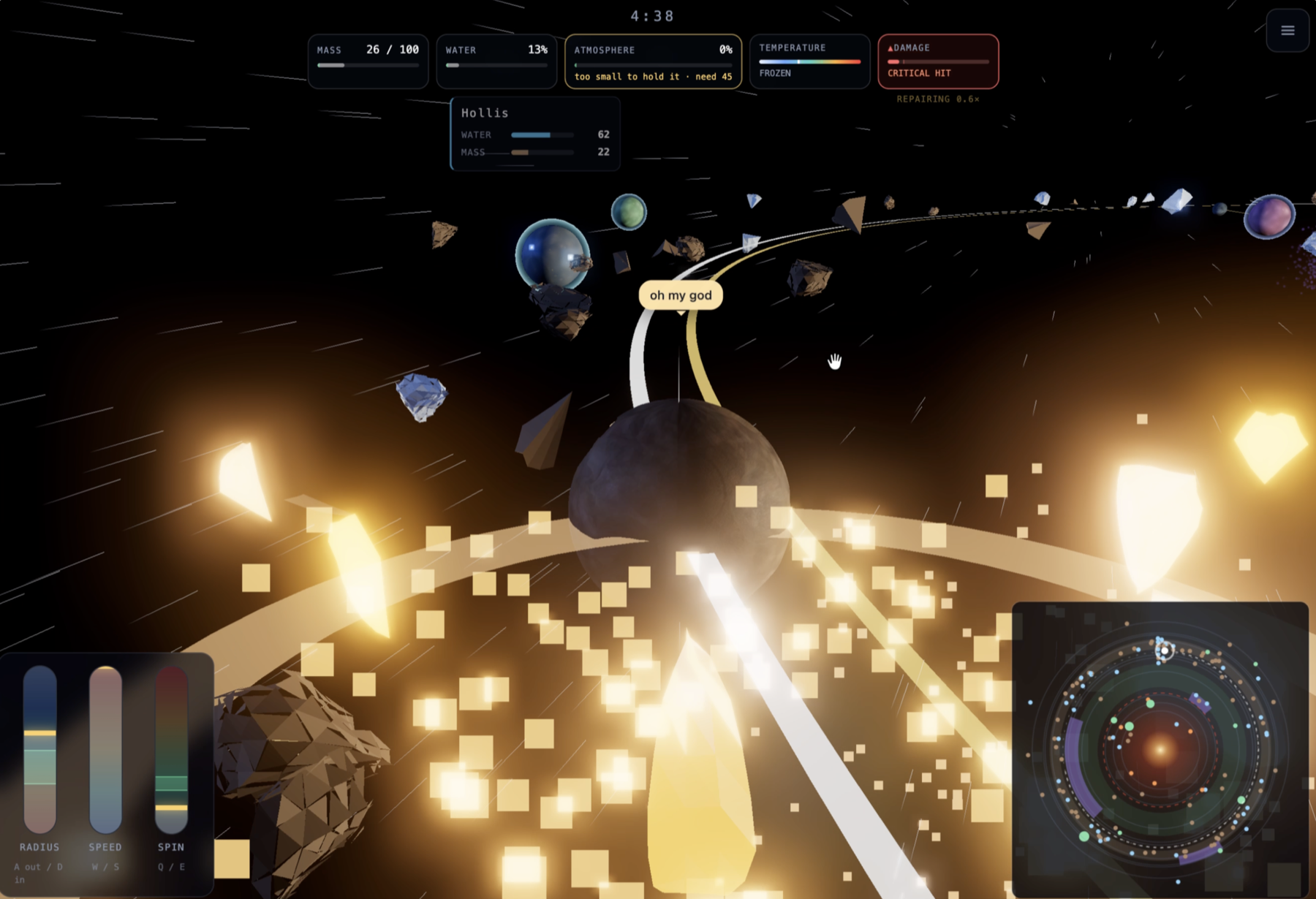
Hit a planet at lower speed and you can change its trajectory. Hit it with enough mass and velocity and you can drive through it completely. That destruction creates debris which remains in orbit, turning the player’s previous aggression into a new navigational hazard.
Other celestial bodies can collide with one another as well. An object you’ve knocked off course can come back around later, collide with something else—or hit you from behind.
The player doesn’t move through a level. The player changes the level while playing it.
Ram
Change another planet’s orbit.
Destroy
Enough mass and velocity breaks it apart.
Debris
Fragments remain in the system.
Navigate
Your shortcut becomes your next obstacle.
Make a mess. Drive through the mess.
The comedy comes from taking the world seriously.
Visually, I resisted turning the planets into cartoon characters. The celestial bodies remain textured, atmospheric, and relatively serious because the absurdity works better when the world itself doesn’t seem to know it’s a joke.
Personality instead comes from behavior. Planets react when the player gets too close, remember repeated collisions, and complain through short speech bubbles while continuing along their orbit.
Believable enough to abuse.
A Hole Planet was never intended to be an astrophysics simulator. Real planets don’t accelerate on command, deliberately change orbital radius, or spin faster because someone is holding a keyboard key. But I also didn’t want the solar system to feel arbitrary.
Mass affects what the player can destroy. Momentum makes changes in speed take time. Temperature depends on orbital position. Damage affects the planet’s ability to retain resources. Collisions alter trajectories. Water freezes farther from the star and evaporates when conditions become too extreme.
Break reality wherever the game needs it. Preserve enough cause and effect that the player still believes the result.
That created the central interaction problem behind the entire prototype: if the player is driving something with planetary mass, the controls can’t feel like they’re driving a car.
02 — Driving a Planet
Familiar controls. Planetary consequences.
I wanted the game to feel immediately understandable to anyone who had played a driving game before. The player has three primary controls: move inward or outward, speed up or slow down, and increase or decrease spin.
But mapping those controls directly to movement made the planet feel weightless. A celestial body shouldn’t stop, accelerate, or change direction the instant a key is pressed.
Instead, player input establishes where the planet is trying to go. Its actual movement responds over time. You control the intention. The planet has to move the mass.
Radius
A / D
Move in / out
Changes the orbit you’re trying to occupy.
Speed
W / S
Faster / slower
Changes how quickly you’re moving around the star.
Spin
Q / E
Rotate
Repairs damage faster — and destabilizes your orbit.
The controls are simple. The response isn’t.
A planet shouldn’t stop on a dime.
The delay between input and response became one of the most important parts of the game. Increasing speed doesn’t instantly launch the player forward. Changing radius doesn’t teleport the planet onto another orbital path. The player has to anticipate where a target will be, begin changing trajectory early, and account for the momentum of the body they’re controlling.
As the player’s mass increases, that sense of inertia becomes increasingly important. What initially feels like a slightly sluggish control scheme becomes the core skill: learning to drive ahead of the planet rather than reacting at the last second.
Input
Move inward
Target orbit
Where the player wants to be
Inertia
Planet gradually responds
Actual orbit
Where the planet really goes
The gap between input and result is the game.
Movement needed to be visible, not just mathematical.
Orbital movement can be difficult to read from a camera that remains centered on the player. If everything else is moving around you, changing speed or radius doesn’t necessarily feel like movement.
I added physical responses to the planet itself so the controls became visible. Moving between orbital paths changes its apparent tilt. Accelerating and decelerating pitches the axis forward and backward. Increasing spin destabilizes the planet and introduces a visible wobble. At higher speeds, background stars stretch into streaks.
Orbit change
Tilt
Acceleration
Pitch
High spin
Wobble
High speed
Star streaks
The HUD tells you what you changed. The planet shows you what it feels like.
Spin became more than a steering control.
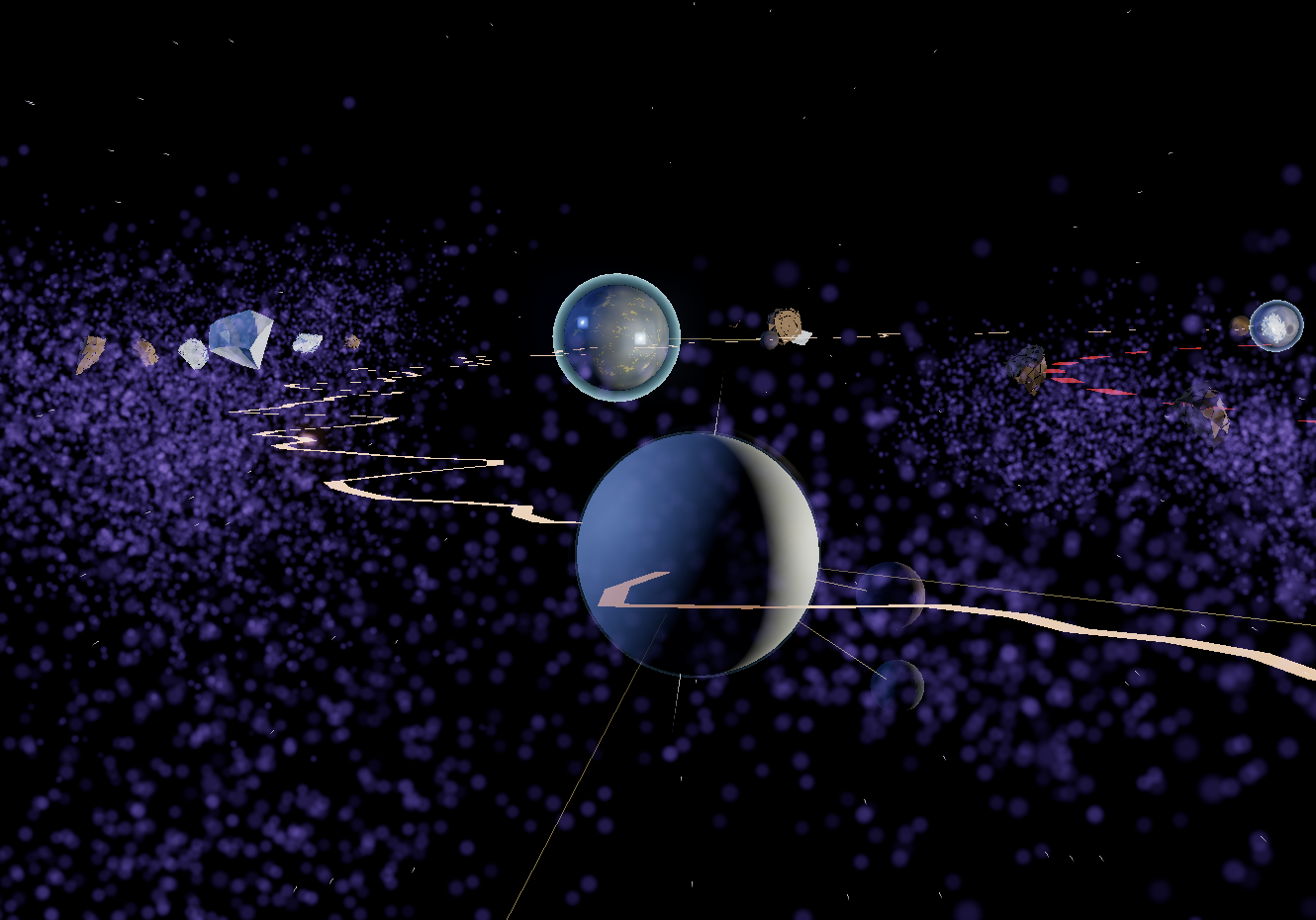
Spin originally belonged to the physical fantasy of controlling a planet, but it became more useful once I connected it to damage recovery. A planet slowly repairs itself at its normal rotation. Increasing spin accelerates that process, giving the player a way to recover quickly after collisions.
The tradeoff is control. High spin destabilizes the planet’s orientation and creates a wobblier orbital path. A short burst can repair meaningful damage, but leaving it elevated makes precision driving much harder.
Spin faster
Repair faster
Up to 4.8× repair rate at maximum rotation.
But
The orbit wobbles
Past the stable limit the pole tilts and the path shakes.
Recovery costs control.
Even collisions had to preserve momentum.
Early collision behavior broke the illusion. Planets reacted at rigid angles, making impacts feel more like objects bouncing around a simple game board than massive bodies exchanging momentum.
I reworked collisions so an impact could redirect both bodies. A lower-energy hit can shove another planet into a different trajectory and speed while disturbing the player’s own orbit. With enough mass and velocity, that same collision crosses a threshold and becomes destructive.
That made ramming useful beyond simply collecting resources. A player can deliberately alter another body’s path—but whatever trajectory they create continues through the system.
Before
Two orbital paths
Impact
Momentum transfers both ways
After
You are displaced. They are on a new trajectory.
30 seconds later
Oh no. It’s you again.
Altered orbits create future encounters
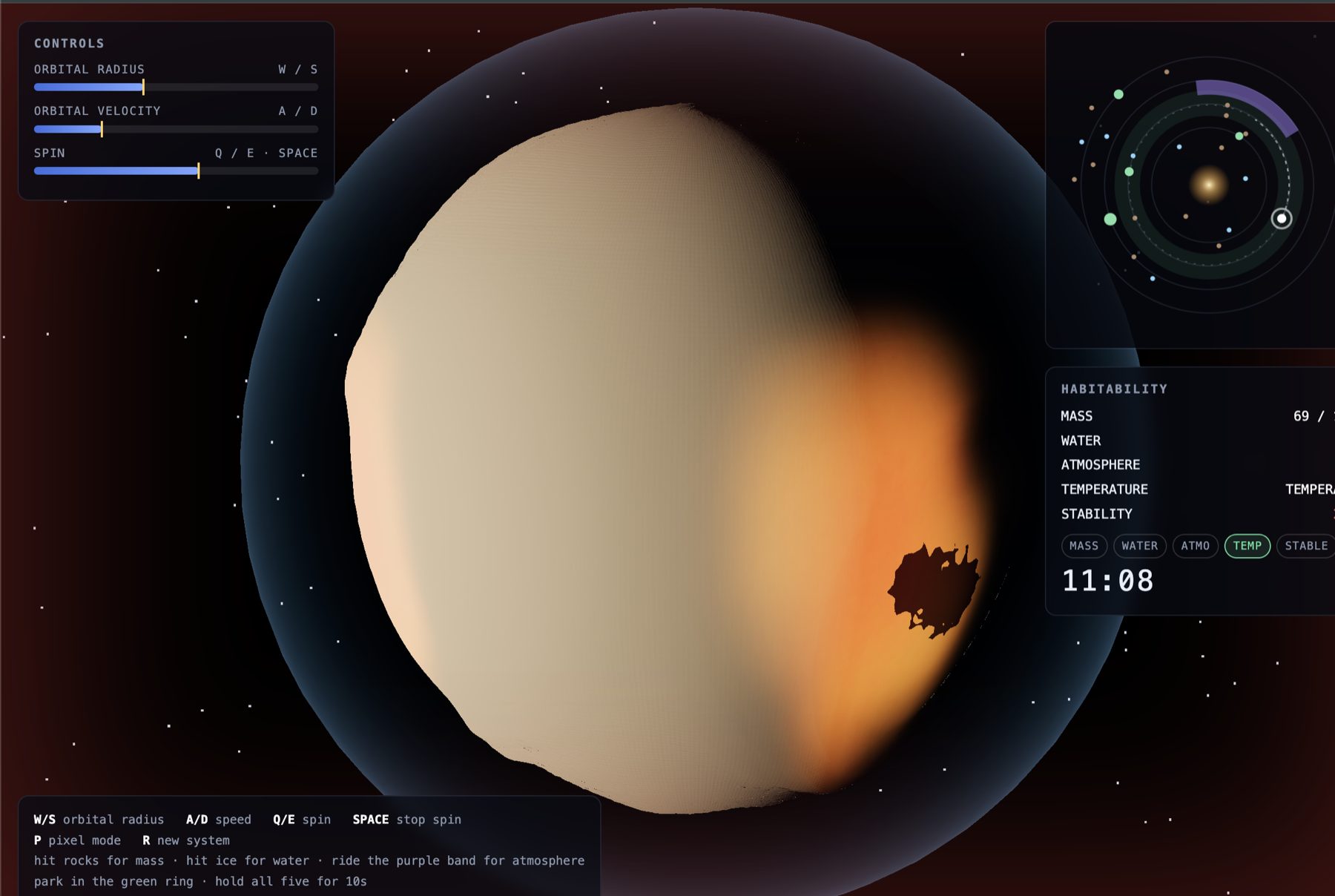
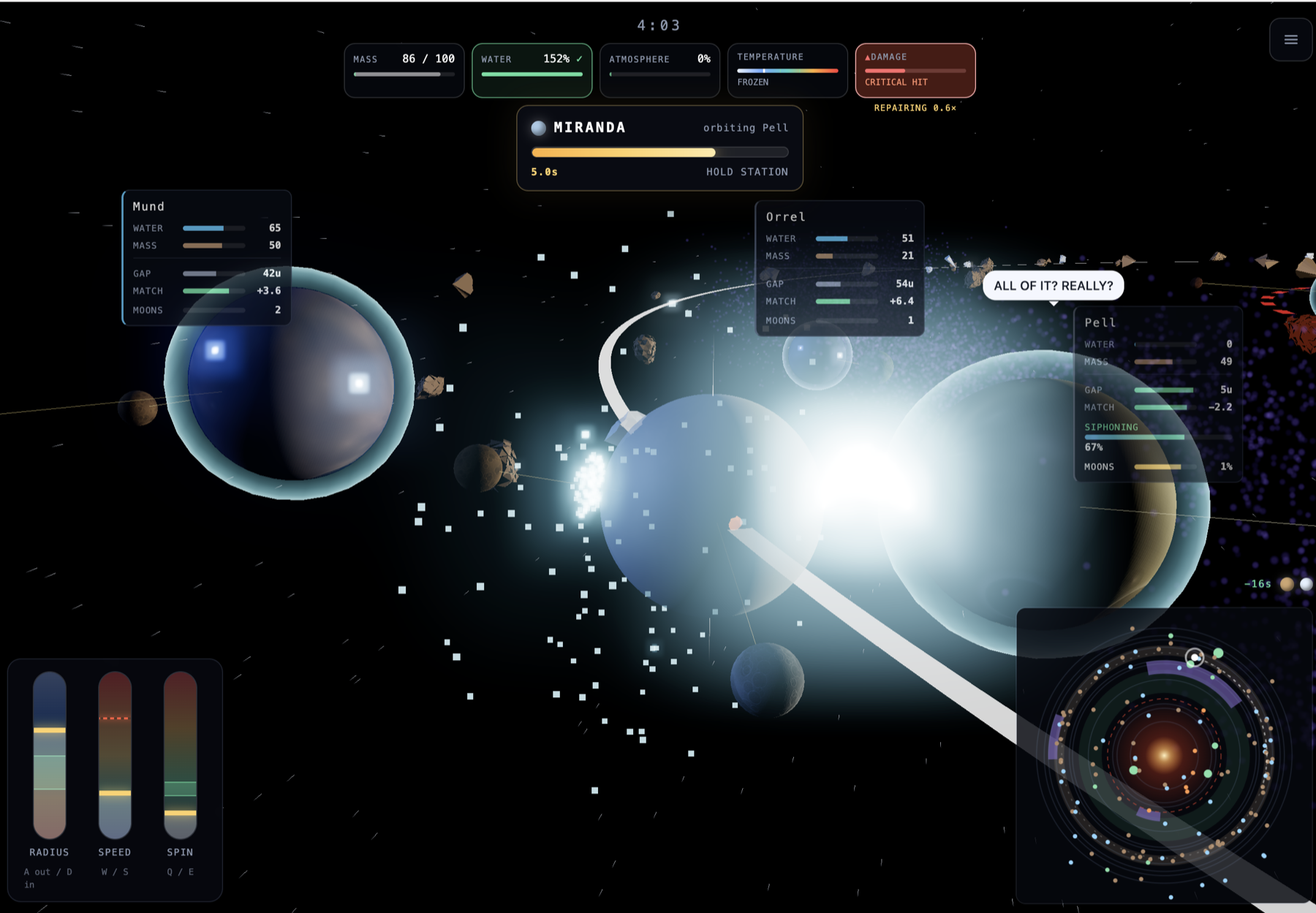
The camera had to sell the fantasy.
The earliest prototype already allowed changes in orbital radius and speed, but the game didn’t feel convincing until the camera behaved correctly.
The player needed to remain visually grounded to their own planet while still reading movement relative to the solar system around them. Once that relationship worked, the unusual control model became much easier to understand: the planet felt like the vehicle, and the rest of the system became the road.
Before
After
Driving without steering
Three inputs. Five questions.
Radius
Which lane of the solar system am I aiming for?
Speed
Where will I intersect another body?
Spin
How much control am I willing to trade for repair?
Mass
How quickly can I respond — and what can I destroy?
Momentum
Where am I actually going?
The player only has three controls.
The system creates the complexity.
Once the planet felt convincing to drive, I could build the rest of the game around one rule: nothing useful should come without a consequence.
Getting bigger makes you more destructive. Destruction fills your orbit with debris. Faster spin repairs damage but destabilizes control. The star can heal you while destroying the resources you’re trying to protect.
Progress and danger became the same system.
03 — Every Advantage Has a Cost
Building a planet means constantly breaking something else.
A Hole Planet has a simple objective: build enough mass, collect enough water and atmosphere, reach a temperate orbit, repair your damage, and hold those conditions long enough for life to emerge.
I didn’t want those requirements to function as five independent progress bars. I designed them to interfere with one another.
The fastest way to gain mass creates debris. The fastest way to repair damage destroys resources. Water can’t survive on a badly damaged planet. Atmosphere can’t be retained until the planet becomes massive enough. And the safest place to preserve everything isn’t necessarily where the resources are.
Progress creates problems. Solving those problems creates new ones.
Five conditions. One interconnected system.
Hit
Build mass by becoming a menace.
The player begins as a small, damaged planetary body with only a fraction of the mass required to support life. Early in a run, asteroids provide relatively safe opportunities to grow.
As mass increases, the player’s relationship with the rest of the solar system changes. Smaller collisions become less threatening, larger celestial bodies become viable targets, and sufficient mass combined with enough velocity allows the player to stop merely knocking planets around and start driving straight through them.
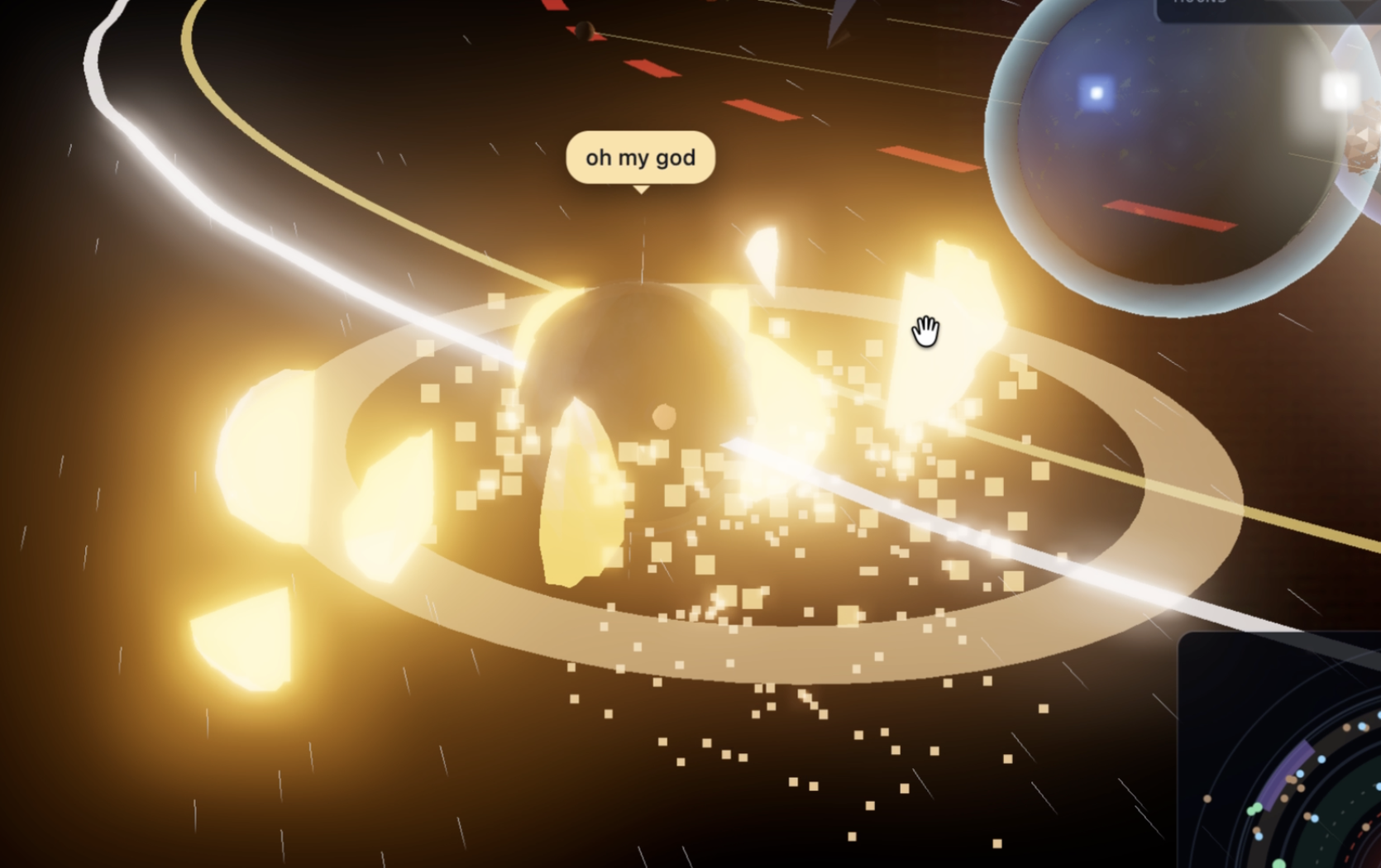
Destruction permanently changes the environment you’re still trying to survive in.
Match
Steal somebody else’s ocean.
Water can’t simply be collected by touching another planet. The player has to pull alongside a water-rich body, close the gap, and match its orbital speed closely enough to establish a stable siphon.
Maintain that relationship and water begins transferring between the two planets: the target visibly dries out while oceans gradually appear across the player’s own surface. Break the speed match or drift too far away and the siphon stops.
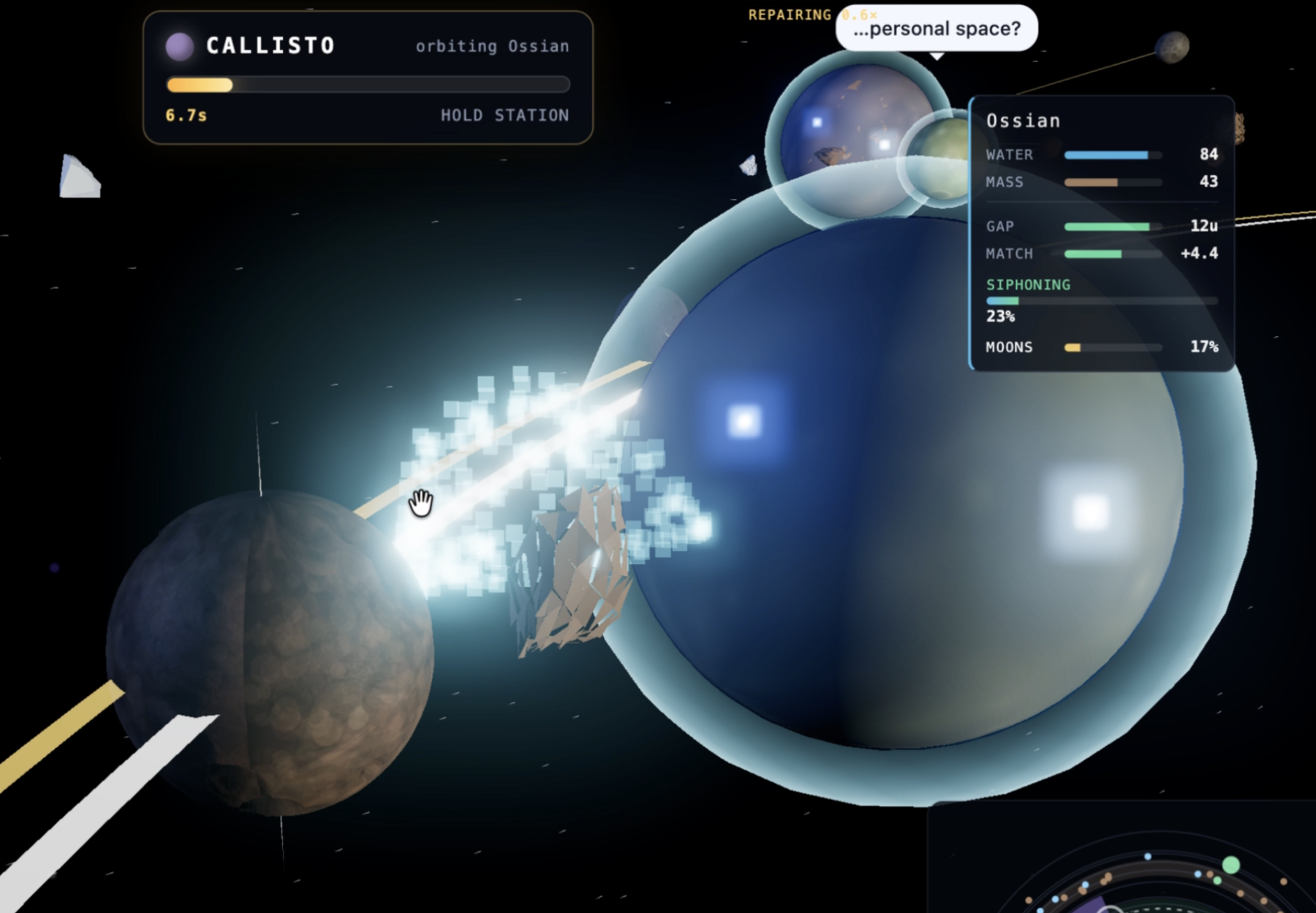
But collecting water doesn’t mean you can keep it.
Water retention depends on the condition of the planet itself. Repeated impacts create location-specific craters, and sufficiently severe damage can expose the core. Once that happens, water begins escaping from the damaged surface.
Temperature creates another constraint. Move too close to the star and oceans evaporate. Move far enough away and the planet visibly freezes, covering the surface in ice until it returns to warmer conditions.
You have to build a planet capable of holding what you steal.
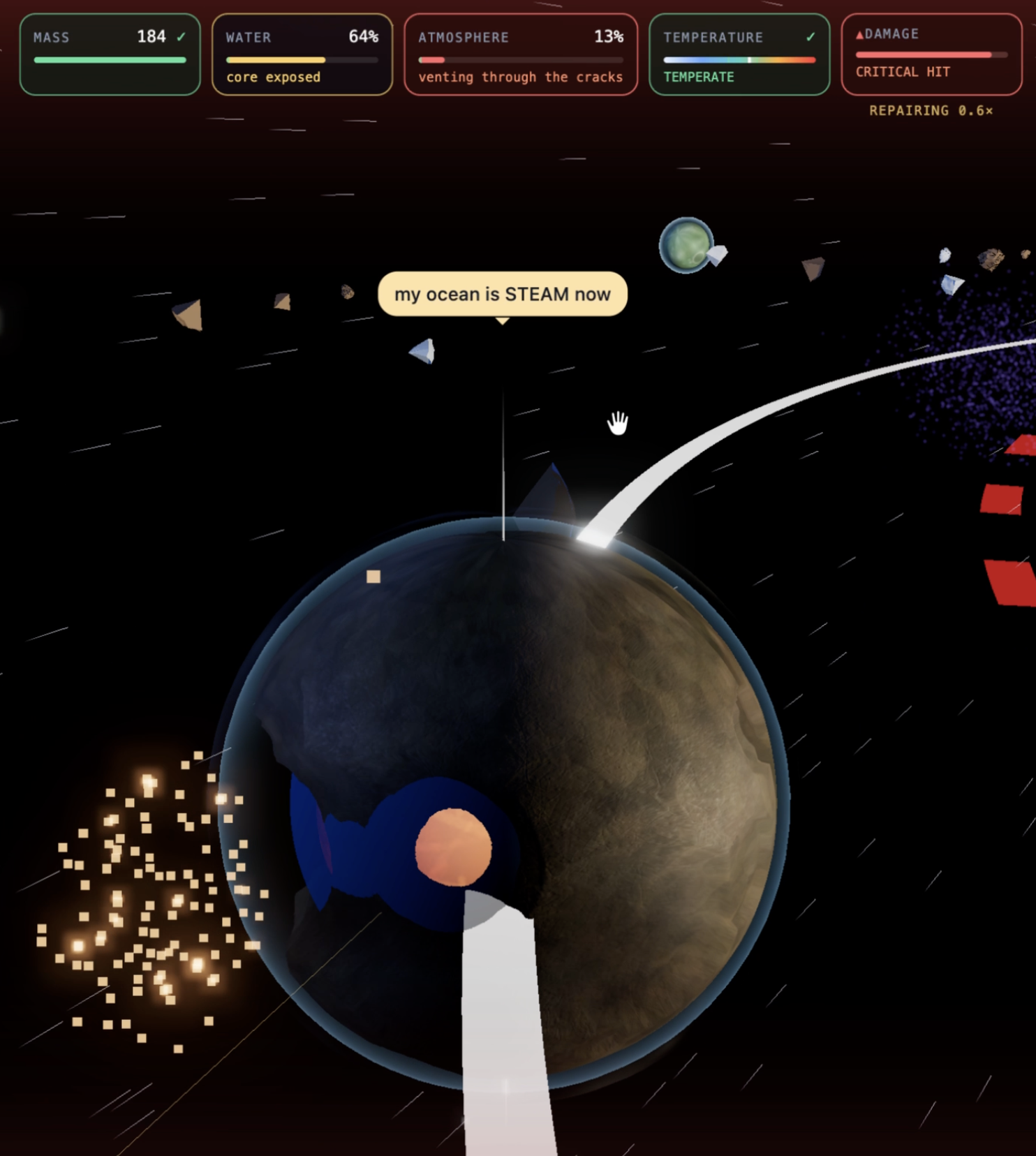
Collect water
Ride
Build an atmosphere without losing it.
Atmosphere introduces another dependency. A planet can’t retain one until it has accumulated enough mass, forcing the player to prioritize growth before atmospheric collection becomes efficient.
Once that threshold is reached, the player can intercept atmospheric clouds distributed throughout the system and ride through them to build the resource. But the same conditions that threaten water threaten atmosphere as well.
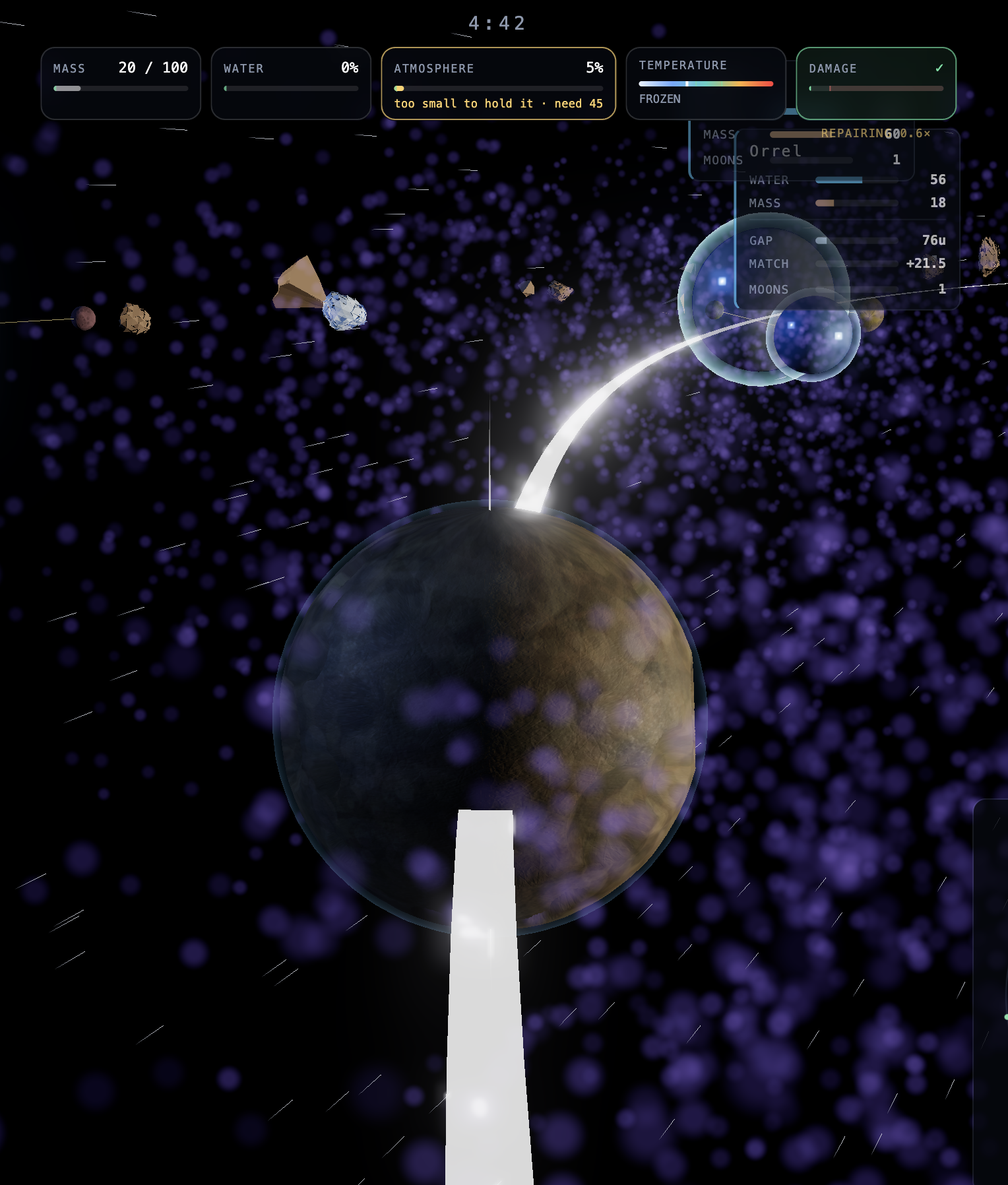
Damage isn’t just a health bar.
Damage is spatial rather than purely numerical. Impacts leave visible craters where the collision occurred, and repeated hits to the same area can eventually expose the planet’s core.
That makes damage part of the resource system rather than simply a fail state. A badly damaged planet becomes less capable of retaining the water and atmosphere required to finish the game. Repair therefore becomes another strategic decision.
Wait
Normal rotation gradually repairs damage.
Safe · slow
Spin
Increase axial rotation to accelerate repair.
Fast · destabilizes orbit
Anneal
Move inside the star’s heat boundary.
Fastest · burns resources
Three ways to heal. None of them free.
The star is both repair shop and threat.
Entering the star’s inner heat zone triggers annealing, rapidly repairing planetary damage. That can rescue a run after a destructive collision or prepare the surface to retain water again.
But the same heat that repairs the planet also strips atmosphere and boils away its ocean. Staying longer means healing faster while destroying more of the progress you’ve already made.
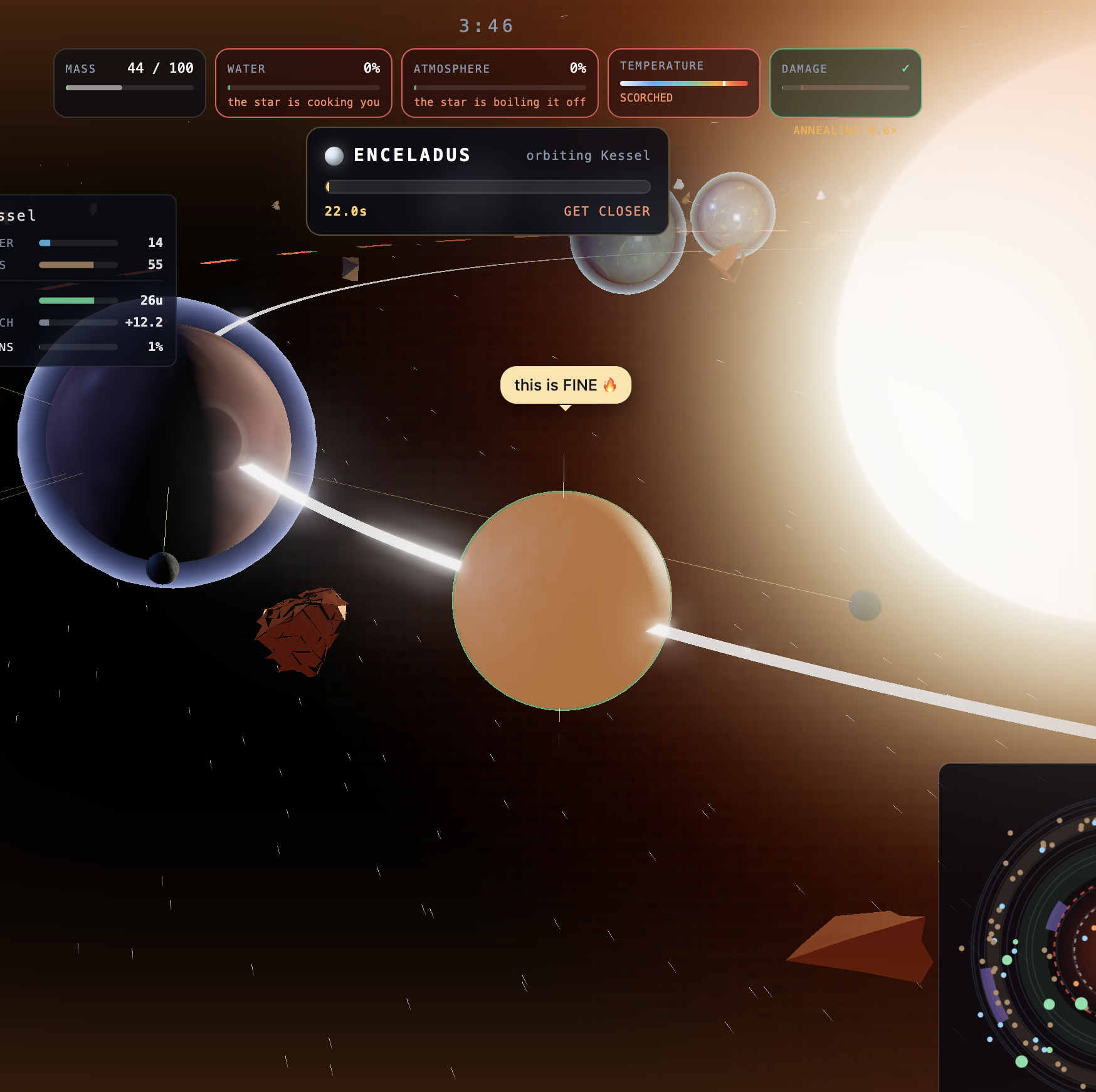
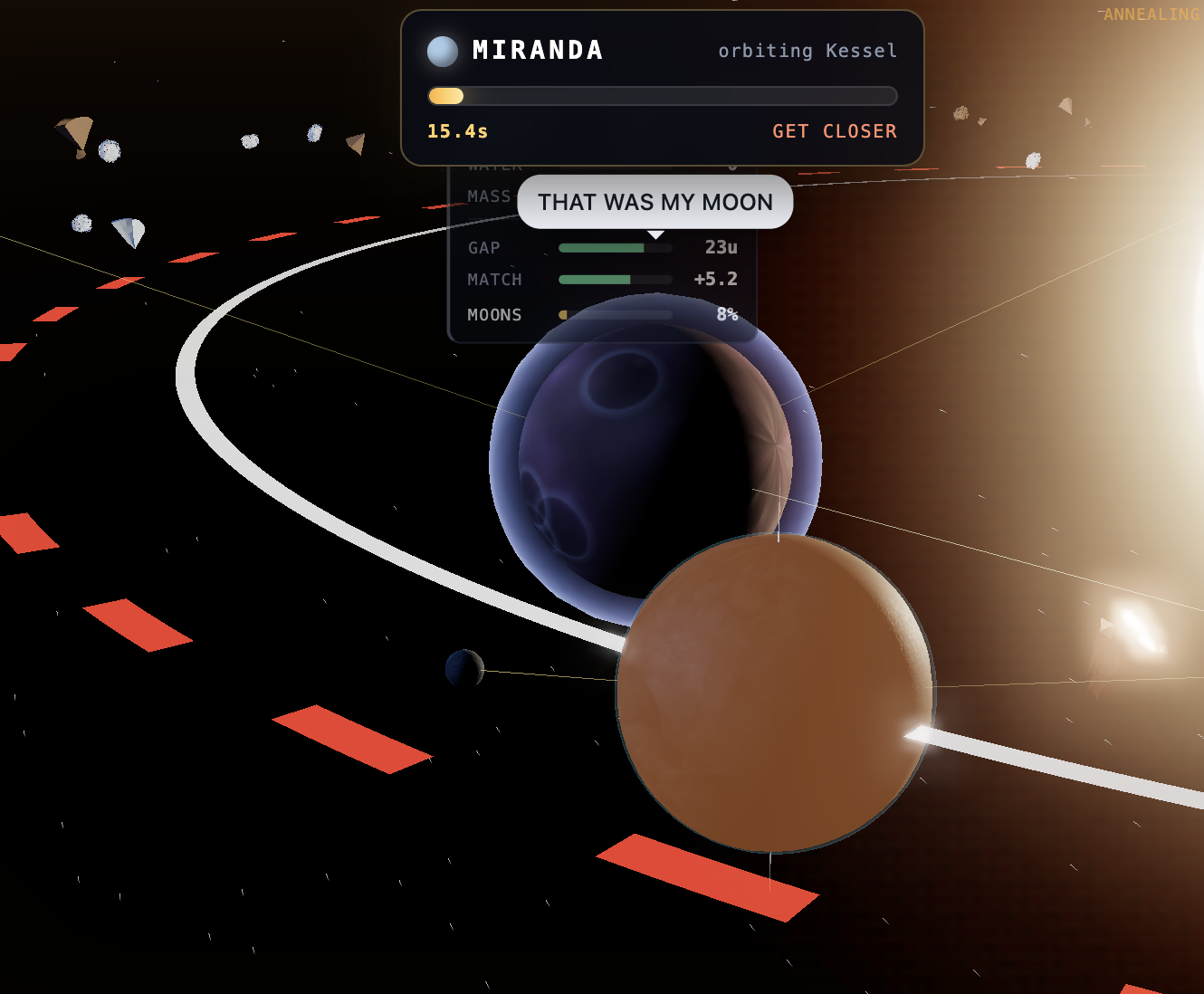
Moons reward precision instead of destruction.
Not every interaction rewards aggression. Moons function as optional time bonuses for players trying to improve leaderboard runs.
Like siphoning, capturing one requires pulling alongside its parent planet and holding position long enough to complete the transfer. Larger moons take longer to steal, forcing the player to decide whether the potential time bonus is worth interrupting a faster route toward habitability.
They aren’t required to create life. They’re there for players who have started optimizing the system rather than simply surviving it.
Park
And then stop messing everything up.
After spending most of the run changing orbit, stealing resources, smashing objects, repairing damage, and generally destabilizing the solar system, the final challenge asks the player to do something completely different: settle down.
To create life, the planet must enter a temperate orbital zone with the required mass, water, atmosphere, and surface condition—and maintain those conditions for ten seconds.
It’s deliberately fragile. Debris is still orbiting. Other planets are still moving. Asteroids can still hit. The player has to hold a stable environment inside the mess they created getting there.
The system loop
Every gain feeds the next problem.
Smash
Gain mass.
creates damage
Steal
Collect water.
needs a matched orbit
Ride
Build atmosphere.
needs mass first
Repair
Undo the damage required to get there.
costs control or resources
Stabilize
Find the habitable zone.
inside the debris you made
The objective is simple.
Every system makes it harder.
Once those systems began interacting, the next problem wasn’t adding more mechanics. It was helping the player understand the ones already there.
A planet can be accelerating, changing orbit, taking localized damage, losing water, approaching a siphon, overheating, repairing itself, and tracking another celestial body at the same time.
If the player can’t understand why something is happening, the system might as well not exist.
04 — Making Chaos Readable
Complexity only matters if the player can understand it.
As the mechanics became more interconnected, the biggest interface challenge was deciding what the player actually needed to know at any given moment.
A single encounter can involve orbital speed, distance, relative velocity, water availability, moons, damage, temperature, resource loss, and nearby hazards—all while the player is still trying to steer.
My early instinct was to expose more of the system. Playtesting pushed me in the opposite direction. The player doesn’t need to understand the simulation. They need enough information to make the next decision.
Keep the mission visible.
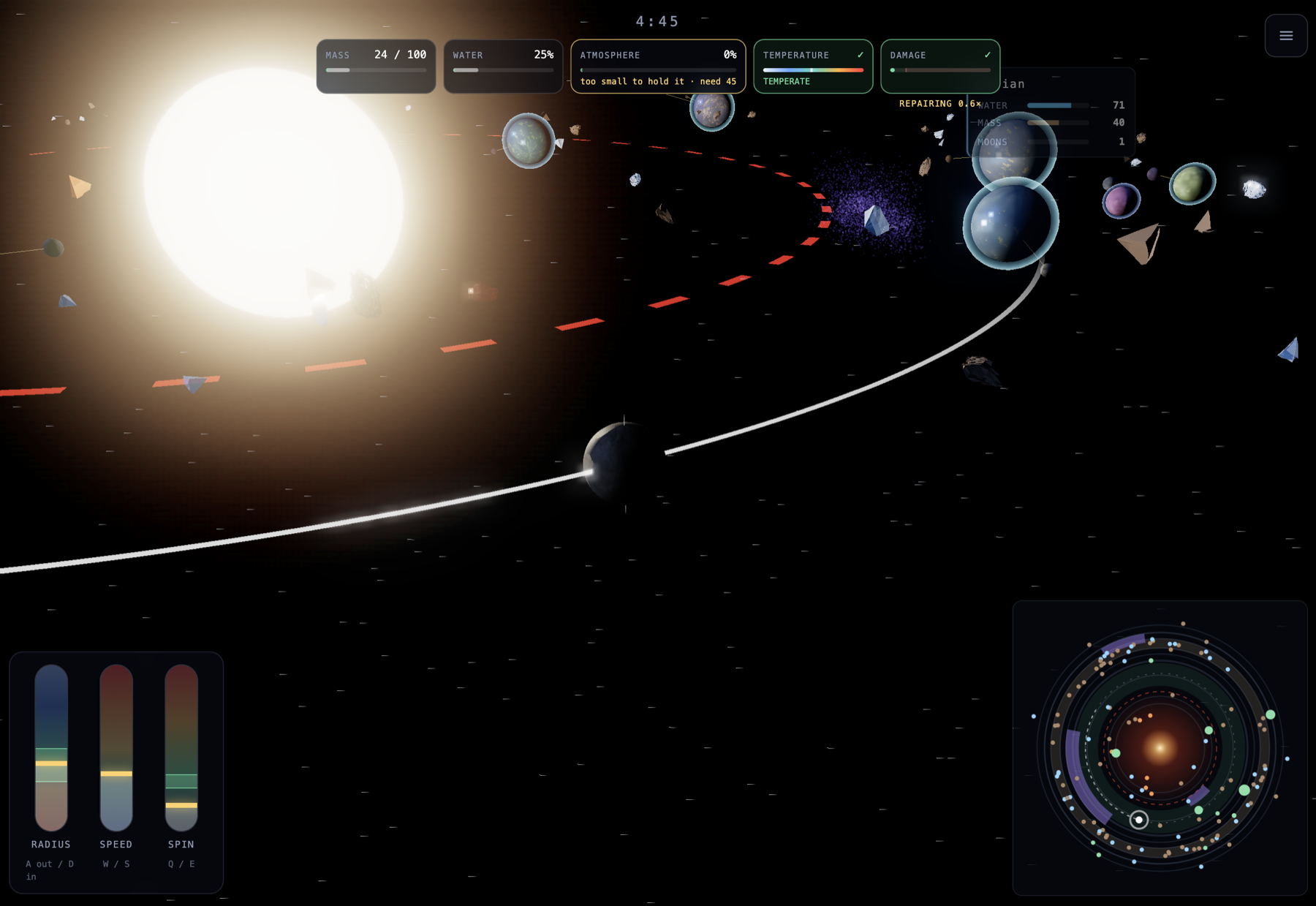
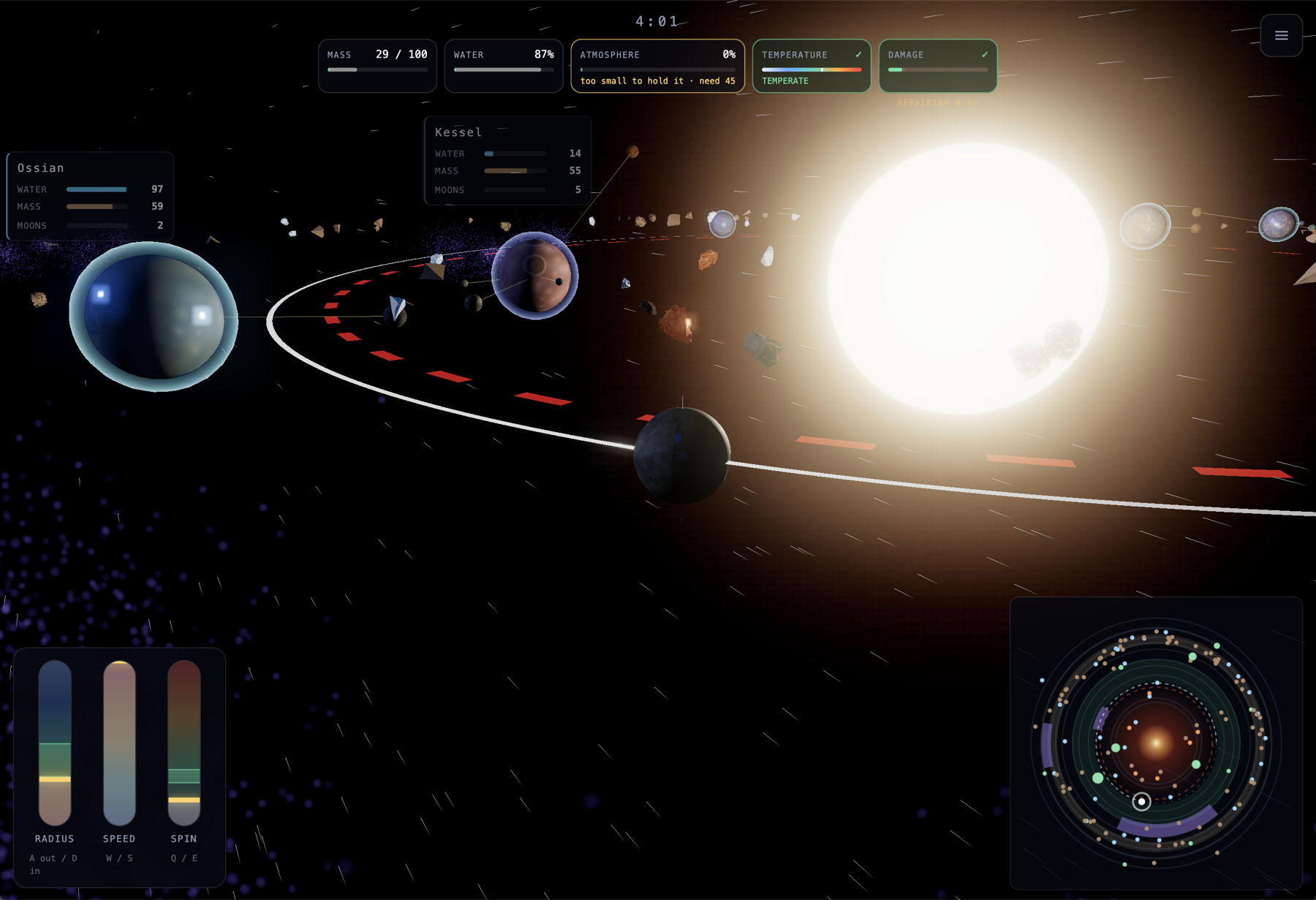
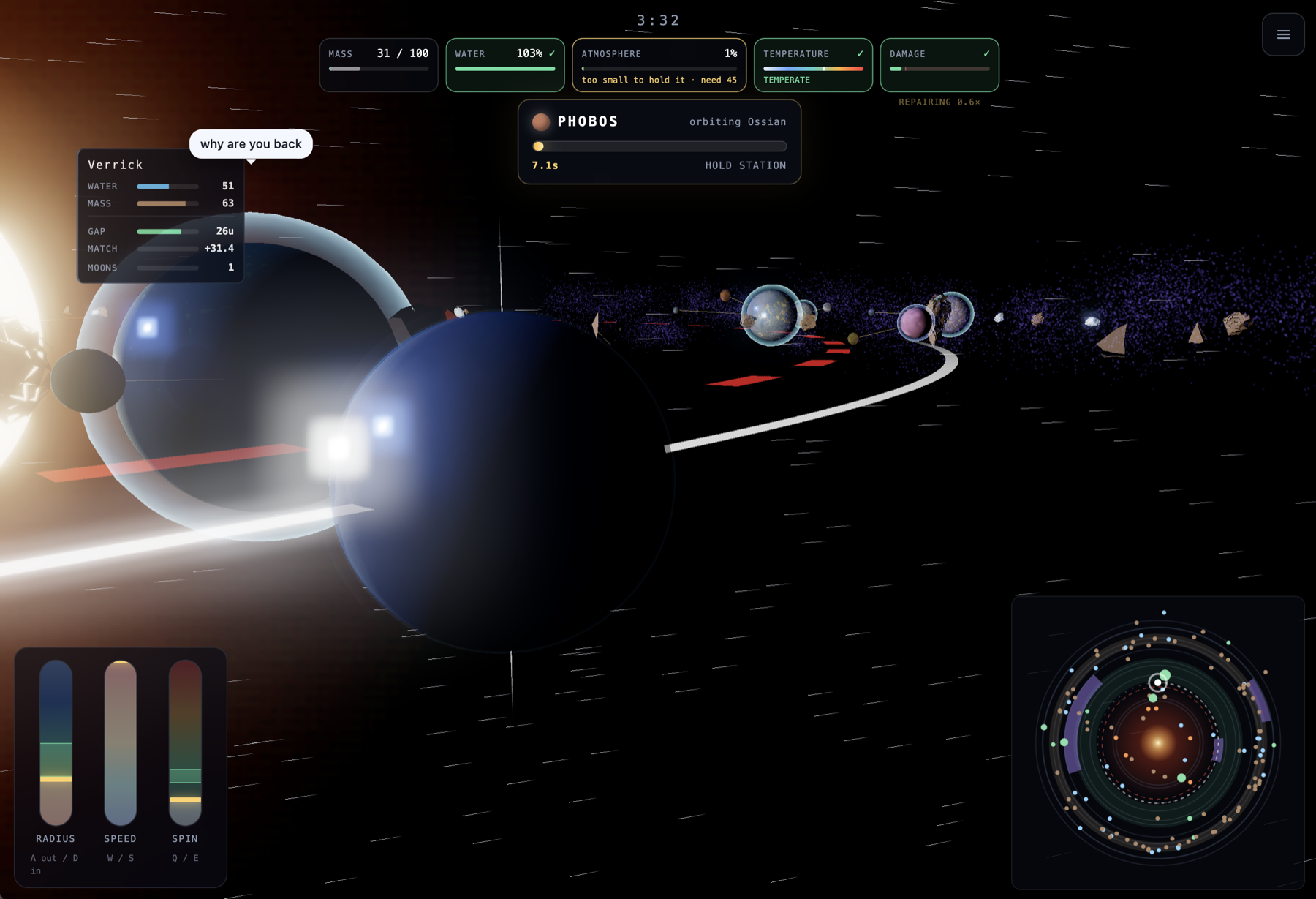
The primary HUD is organized around the five conditions required to create life: mass, water, atmosphere, temperature, and damage.
Rather than functioning as passive progress bars, each panel changes with the state of the planet. Atmosphere explains when the player is too small to retain it. Temperature shifts between frozen, temperate, and scorched conditions. Damage surfaces repair behavior.

Mass
Can I destroy larger bodies yet?
Water
How close am I to habitability?
Atmosphere
Can I retain air yet?
Temperature
Can my resources survive here?
Damage
Can my planet hold them?
Five systems. One finish line.
Only show detail when it becomes useful.
The solar system contains far more information than can remain on screen permanently. Instead of giving every celestial body a persistent interface, nearby planets reveal contextual information only when they become relevant to the player.
Approach another planet and a panel exposes the information needed to interact with it: available water, mass, moons, distance, and relative speed. The closer the player gets to an actionable state, the more specific the feedback becomes.
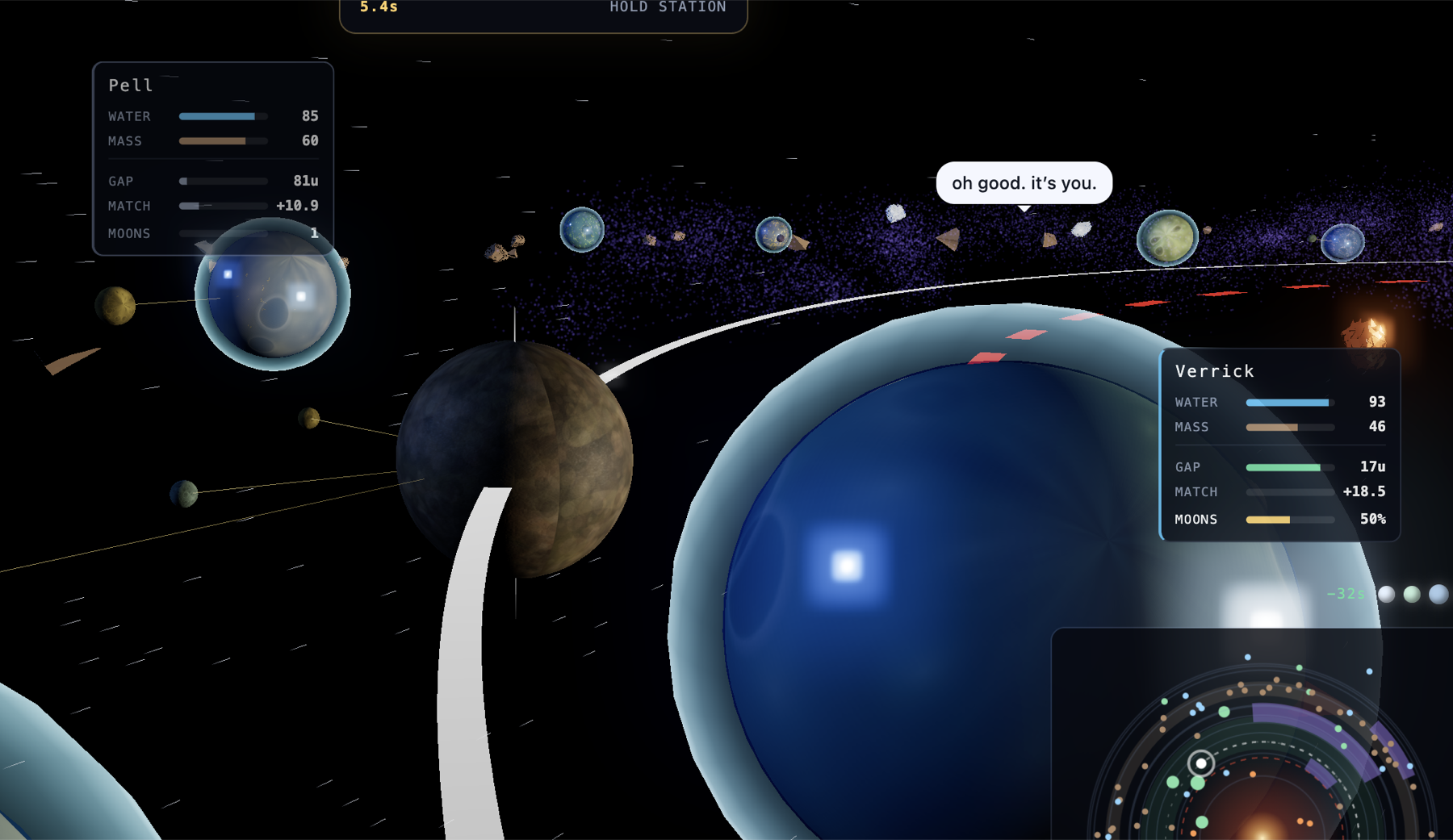
Gap
How far away am I?
Match
How closely are our speeds aligned?
Water
Is this planet worth siphoning?
Moons
Is there a time bonus worth stealing?
Don’t show everything about the planet. Show what the player can do with it.
Turn invisible relationships into visible targets.
Some of the most important mechanics depend on relationships the player can’t judge precisely from the 3D scene alone. Two planets can appear close together while moving at very different velocities.
GAP and MATCH translate that invisible relationship into something actionable. Once both enter the required range, the interface changes state and a siphoning progress bar confirms that the player has successfully established the maneuver.
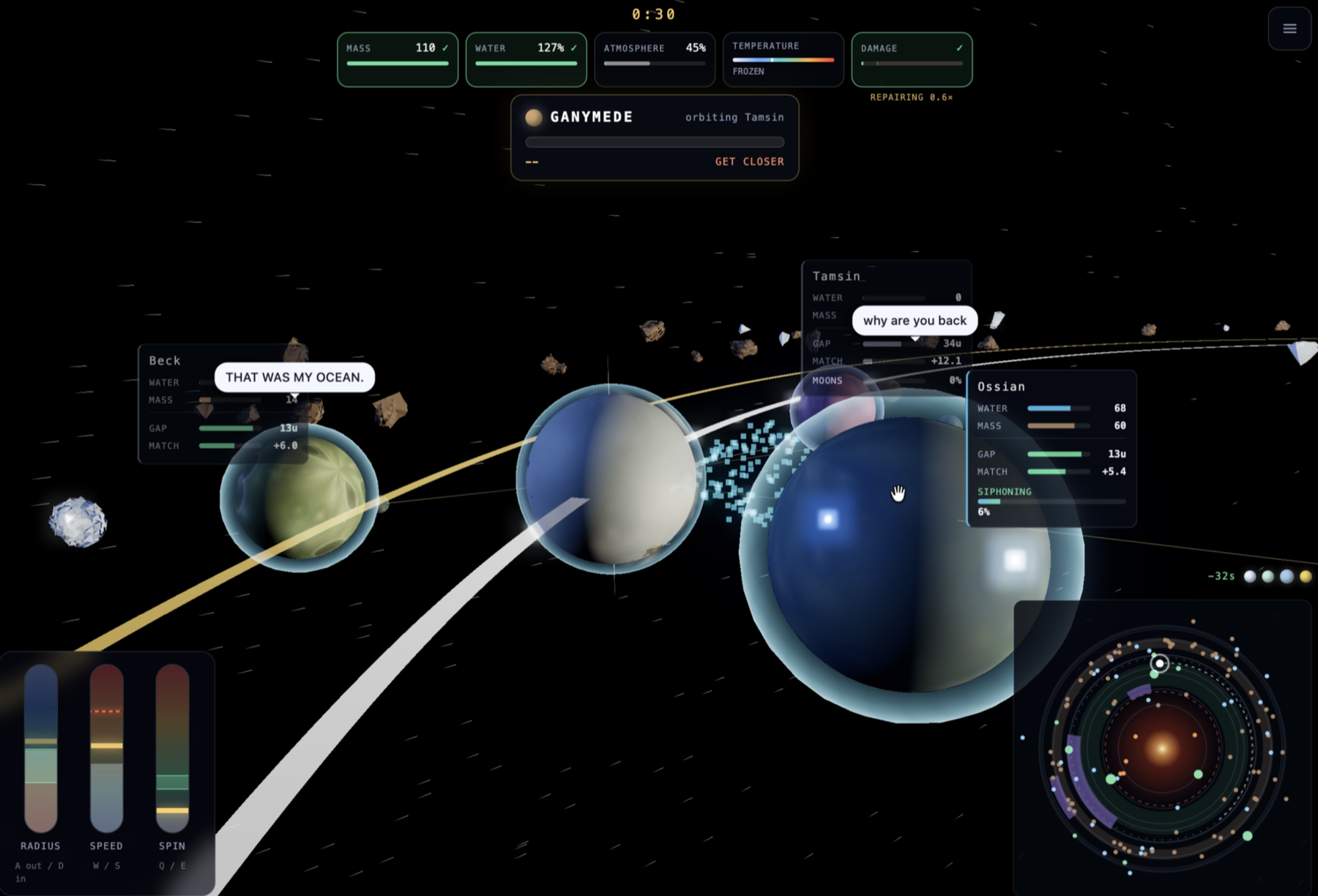
Gap
86
units
Match
4.7
Δv
Close the gap · match velocity
The planet itself became part of the interface.
Not every state needed another panel. Damage appears physically where the planet was hit. Repeated impacts deepen the same area until the core becomes visible. Water gradually covers the surface as it’s collected. Move into colder orbit and that surface freezes.
Those effects aren’t only visual polish. They reduce the amount of abstract information the HUD has to communicate.
Dry
Rock surface
Water
Ocean appears
Frozen
Surface ices over
Damaged
Craters deepen
Core exposed
Resources escape
If the player can see it, don’t make them read it.
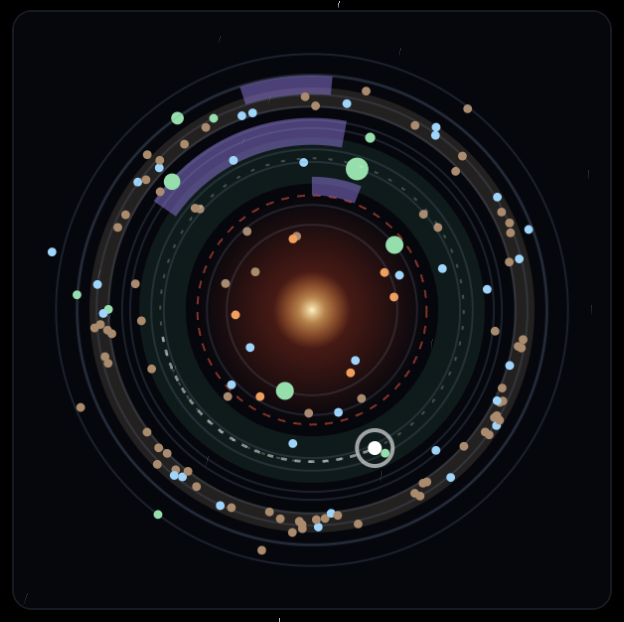
The minimap answers “where the heck am I?”
Keeping the camera close enough to make the planet feel controllable creates another problem: the player loses a global view of the solar system.
I added the orbital map as a navigation layer rather than forcing players to constantly zoom out and search the 3D environment. It shows the player’s position relative to other celestial bodies and atmospheric resources, allowing someone to identify a target and plan the next orbital move without abandoning the driving view.
Warnings needed to explain cause, not just failure.
Because several resources can increase or decrease for different reasons, a changing number alone isn’t sufficient feedback.
Warning states explain the cause of the change whenever possible: the planet is too small to hold atmosphere, the star is boiling away water, damage is allowing resources to escape, or the current orbit is outside a temperate range. That turns failure into information the player can immediately act on.
Not enough
Water 34% → 28%
Why?
Better
Water 34% ↓
The star is boiling you
Move outward.
Feedback should answer “what do I do?” before the player has to ask “what happened?”
Humor became feedback too.
The neighboring planets provided another feedback channel—just one that didn’t need to sound like a system message. Get too close and they become uncomfortable. Hit one and it complains. Hit the same planet again and it remembers you.
I learned to remove information, not just organize it.
Designing A Hole Planet challenged one of my own tendencies: when a system becomes more sophisticated, it’s tempting to expose that sophistication in the interface. The opposite usually made the game better.
Controls became easier to understand when they were reduced to three inputs. Planet information became clearer when it appeared contextually. Physical changes replaced abstract indicators where possible. Feedback became more useful when it explained consequences instead of exposing mechanics.
An impressive system isn’t useful if the person playing it is the only one who doesn’t understand what’s happening.
The system can be complex.
The decision shouldn’t be.
05 — Built in a Weekend
Saturday morning: a planet going in circles. Sunday night: a game.
The first version of A Hole Planet was barely a game. The player could move a sphere inward and outward between orbital paths and adjust its speed around a placeholder sun. There were no collisions, no resources, no stars, no destruction, and nothing else in the system could meaningfully interact with you.
But the central interaction felt promising enough to keep going.
Over the course of a weekend, I expanded that prototype into a playable five-minute game with a generated solar system, interactive celestial bodies, collision physics, localized damage, resource collection, environmental states, contextual UI, visual effects, scoring, and a persistent leaderboard.
The goal wasn’t to build a lot of features quickly. It was to find out whether the stupid idea was actually fun. It was.
Saturday morning
Planet goes in a circle
Yellow PNG sun. No stars. No collisions. Radius and speed only.
Sunday night
A game
One weekend
Build the rules first. Let the visuals serve them.
I designed the game as an interconnected set of rules rather than a sequence of scripted events. Celestial bodies have orbital position, speed, and mass. Collisions can alter trajectories. Damage is stored spatially rather than as a purely cosmetic effect. Destroyed planets become persistent debris.
That separation allowed the visual layer to communicate what the underlying simulation was already doing rather than inventing effects solely for appearance.
Player input
Radius · Speed · Spin
Simulation
Orbits · Mass · Collisions · Damage · Resources · Win state
Game state
3D world
Planets · Craters · Oceans · Ice · Debris · Effects
Interface
HUD · Targets · Map · Feedback
The simulation decides what happened.
The renderer makes you feel it.
One system. A lot of moving parts.
126
Celestial Bodies
128 × 32
Localized Damage Grid
20
Code Modules
5,817
Lines
0
Application Servers
AI accelerated implementation. I owned the game.
I used Claude extensively to implement the code while I focused on designing the game itself: the premise, mechanics, interaction rules, control behavior, risk/reward relationships, UI structure, visual direction, and continual playtesting and tuning.
The workflow was highly iterative. I’d define how a mechanic should behave, test the implementation in the browser, identify where the interaction stopped feeling intuitive or fun, and revise the rules until it clicked.
AI dramatically compressed the distance between “what if this worked?” and “let me play it.” It didn’t eliminate the design decisions required once the thing existed.
I designed the rules.
AI helped me make them playable.
The game needed real failure states, not a demo path.
A Hole Planet isn’t a scripted demonstration with a predetermined successful path. The same interacting systems that create the intended experience can also produce unexpected situations: planets collide without the player’s involvement, altered trajectories create later encounters, destroyed worlds fill useful orbital lanes with debris, and badly timed damage can undo several minutes of resource collection.
That unpredictability became part of the appeal. Once the rules worked together, the game started producing situations I hadn’t explicitly designed.
I designed the system.
The system started surprising me.
Even the leaderboard stays lightweight.
Because A Hole Planet is designed around short repeatable runs, completion time naturally became the competitive layer. The browser submits finished runs directly to Firestore, where validation rules reject impossible scores before they’re added to the leaderboard.
There is no custom application server behind it—the playable prototype remains essentially a browser game with a lightweight persistence layer.
Fast didn’t mean finished.
The weekend build proved the mechanic, not the final game. I’m continuing to refine the interface, environmental behavior, and physical interactions—including stronger gravitational effects near the star and the ability to push celestial bodies completely out of orbit.
But those are extensions of a loop that already works. By Sunday night, the question had changed from “Can this be a game?” to “How far can I push it?”
TypeScript · Three.js · Vite · Firestore
06 — What I Learned
Complexity has to disappear into intuition.
A Hole Planet started as a joke about driving something that shouldn’t be drivable. Building it turned into an exercise in making a complicated system understandable without removing what made it interesting.
The more mechanics I added, the clearer one thing became: complexity isn’t valuable just because it’s impressive.
Orbital movement, momentum, localized damage, resource retention, temperature, collisions, environmental effects, and dozens of moving celestial bodies can all exist underneath the experience. But if the player can’t understand what their three controls do—or why their ocean just disappeared—none of that sophistication matters.
The system can be complex.
The decision shouldn’t be.
Constraints created the game.
Some of the mechanics I initially treated as limitations became the things that made A Hole Planet feel distinctive.
The planet couldn’t respond instantly without feeling weightless, so inertia became part of the challenge. Repair needed a purpose, so spin became a risk/reward mechanic. Destruction needed consequences, so shattered planets became persistent debris. Resource collection needed more than progress bars, so water, atmosphere, damage, mass, and temperature became dependent on one another.
The game became more interesting when I stopped trying to make everything convenient for the player.
Playtesting changed what I valued.
Building the system made me want to expose more of it. Playing the system made me want to remove things.
I simplified controls, made information contextual, pushed feedback into the environment, and focused the interface on immediate decisions rather than underlying mechanics.
If the creator has to explain how impressive the system is, the experience isn’t doing enough of the work.
AI changed the speed of experimentation.
AI-assisted development let me test ideas at a speed that would have been unrealistic for me otherwise. More importantly, it changed what I could prototype. Instead of stopping at a storyboard or interaction concept, I could put the actual mechanic in my hands, discover why it didn’t work, and make another decision.
The prototype became part of the design process—not just the artifact at the end of it.
Not every experiment needs to become a company.
A Hole Planet is still an active experiment, not a commercial product. I’m continuing to polish the playable prototype because the core interaction is fun and there are still ideas worth testing.
I’m deliberately not attaching a larger business story to it. The project already answered the question that justified building it: can a ridiculous idea survive contact with an actual player?
In this case, yes.
A Hole Planet
You are a planet.
You need to create life.
Unfortunately, you’re an asshole.
Game Design · Interaction Design · Systems Design · Visual Direction · AI-Assisted Development