ZEITLIGHT
Separating what demands attention from what actually has consequence.
News platforms are designed to keep information moving. Breaking policy, celebrity controversy, market shifts, sports, disasters, and scientific developments all compete within the same feed—often using the same mechanics to earn attention regardless of their actual consequence.
I started Zeitlight after becoming frustrated with the emotional cost of staying informed. My first experiments attempted to classify news by the emotions it created, but testing exposed a fundamental problem: emotional response depends heavily on the individual.
That failure led to a more useful model.
Instead of trying to determine how a story should make someone feel, I began separating two different signals: how strongly a story demands attention and how much structural consequence it carries.
Zeitlight became a working system built around that distinction.
Over roughly one month, I developed the brand, product strategy, UX/UI, information architecture, scoring methodology, data structure, and production pipeline, using AI-assisted development to implement the codebase. The resulting system continuously ingests live news, classifies and evaluates each article through category-specific rules, and translates those results into two interfaces designed to make the information landscape easier to navigate.
In Action
395,228
Articles Processed
~70
Live Sources
8
Information Categories
~10
Structured Evaluations Per Article
5 min
Automated Ingestion Cycle
01 — The Model
Attention Is Not Impact
News stories can demand enormous attention without creating meaningful real-world consequences—and consequential events can develop without dominating the conversation.
Zeitlight separates those signals into two dimensions: Attention Gravity, measuring how strongly a story pulls attention, and Systemic Impact, measuring the scale of its potential real-world consequences. Together, they create a simple framework for understanding not just what’s getting attention, but what may actually matter.
The goal wasn’t to decide what people should care about. It was to separate the intensity of attention from the scale of consequence.
02 — The System
Turning ambiguity into structured data
Zeitlight doesn’t ask an AI model to decide how important a story is. I designed a constrained evaluation system that breaks that judgment into smaller, category-specific questions with predefined responses.
Each article moves through ingestion, classification, evaluation, and deterministic normalization before receiving its final Attention Gravity and Systemic Impact scores. This hybrid approach uses a language model to interpret ambiguous information while keeping the scoring framework and final normalization governed by explicit rules.
03 — Evaluate · Language model
- ~5 Attention questions per article
- ~5 Impact questions per article
- Model selects from predefined responses
03 — Governance
Different information requires different rules.
A single definition of “importance” doesn’t work across every kind of news. A celebrity controversy, hurricane, policy decision, and scientific discovery create attention and consequence in fundamentally different ways.
I designed separate evaluation frameworks for each of Zeitlight’s eight categories. Every article is routed through roughly ten constrained questions—split between Attention Gravity and Systemic Impact—using criteria specific to the type of information being evaluated.
Those responses are then normalized through category-specific weights, curves, and ceilings. This prevents naturally high-attention categories from dominating the system while still allowing exceptional stories to move beyond their typical range.
8 Categories · 8 Evaluation Frameworks · ~10 Constrained Questions Per Article
Attention Gravity
How personally vulnerable or physically threatened is the average person likely to feel?
How strongly could this contribute to public perception of societal instability or disorder?
Across how many major media systems or regions is this actively being covered?
How strongly does this challenge moral boundaries or trigger outrage?
Systemic Impact
What scale of casualties, fatalities, or physical harm is directly associated?
How significantly is transportation, utilities, or public infrastructure disrupted?
What scale of institutions, governments, or populations are directly involved?
How long are the humanitarian or systemic consequences likely to remain active?
Live evaluation variables · try selecting a response
Constrained Model
GPT-4o interprets the article, but it cannot invent the scoring criteria or return an arbitrary importance score. It selects from predefined responses within the evaluation framework I designed.
Deterministic Normalization
Those responses are converted into scores through explicit weighting, curves, and category rules before the article enters the live system.
Production ceiling values · shared/constants/categoryCeilings.ts
Preventing attention from masquerading as impact
Category rules act as guardrails around the scoring model. A highly viral celebrity story can register significant Attention Gravity without automatically receiving the same Systemic Impact potential as a major disaster, policy shift, or economic event.
I tuned these rules against live incoming stories, adjusting category behavior when real-world outputs exposed weaknesses in the model.
04 — Product Design
The system made sense. The interface didn’t.
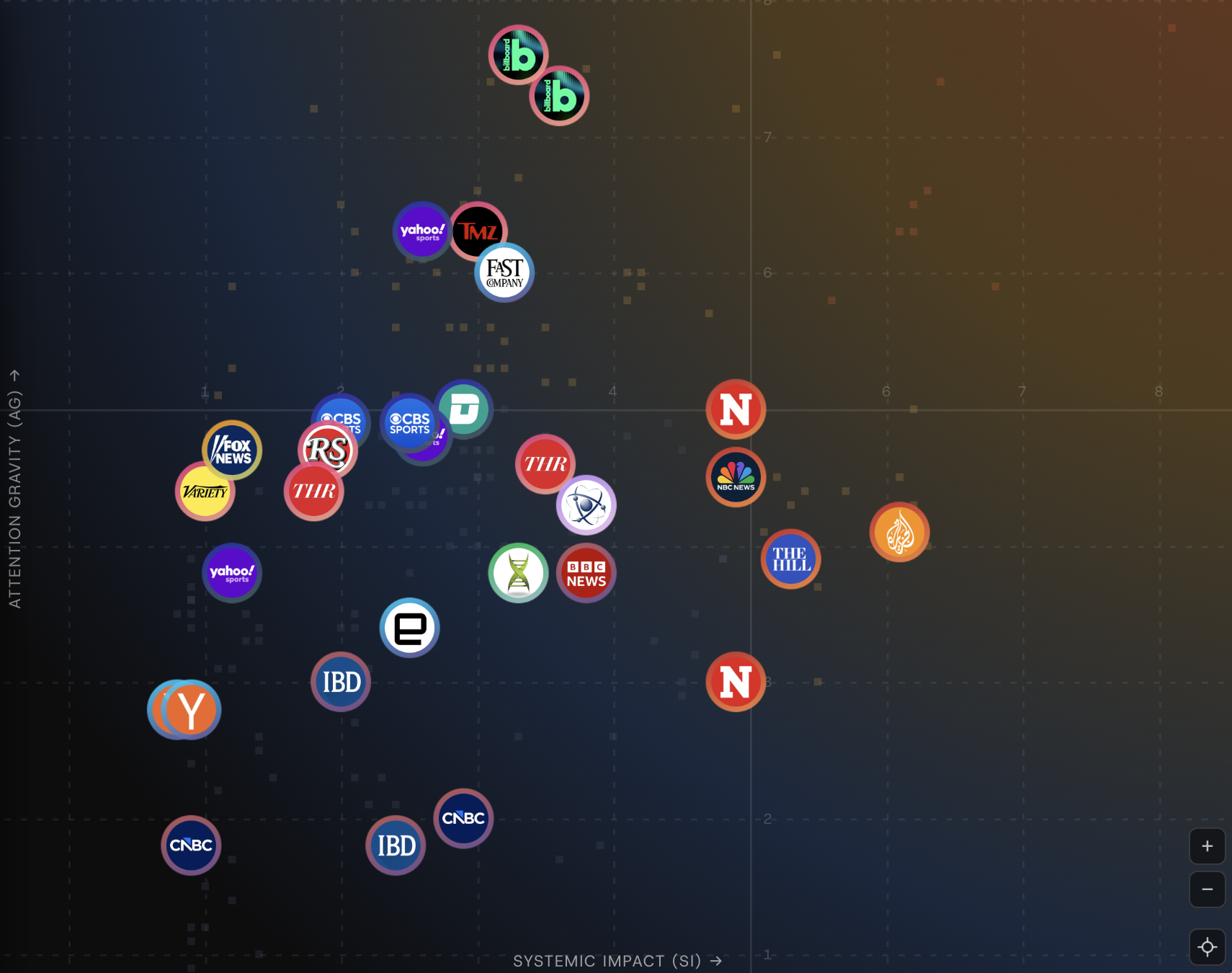
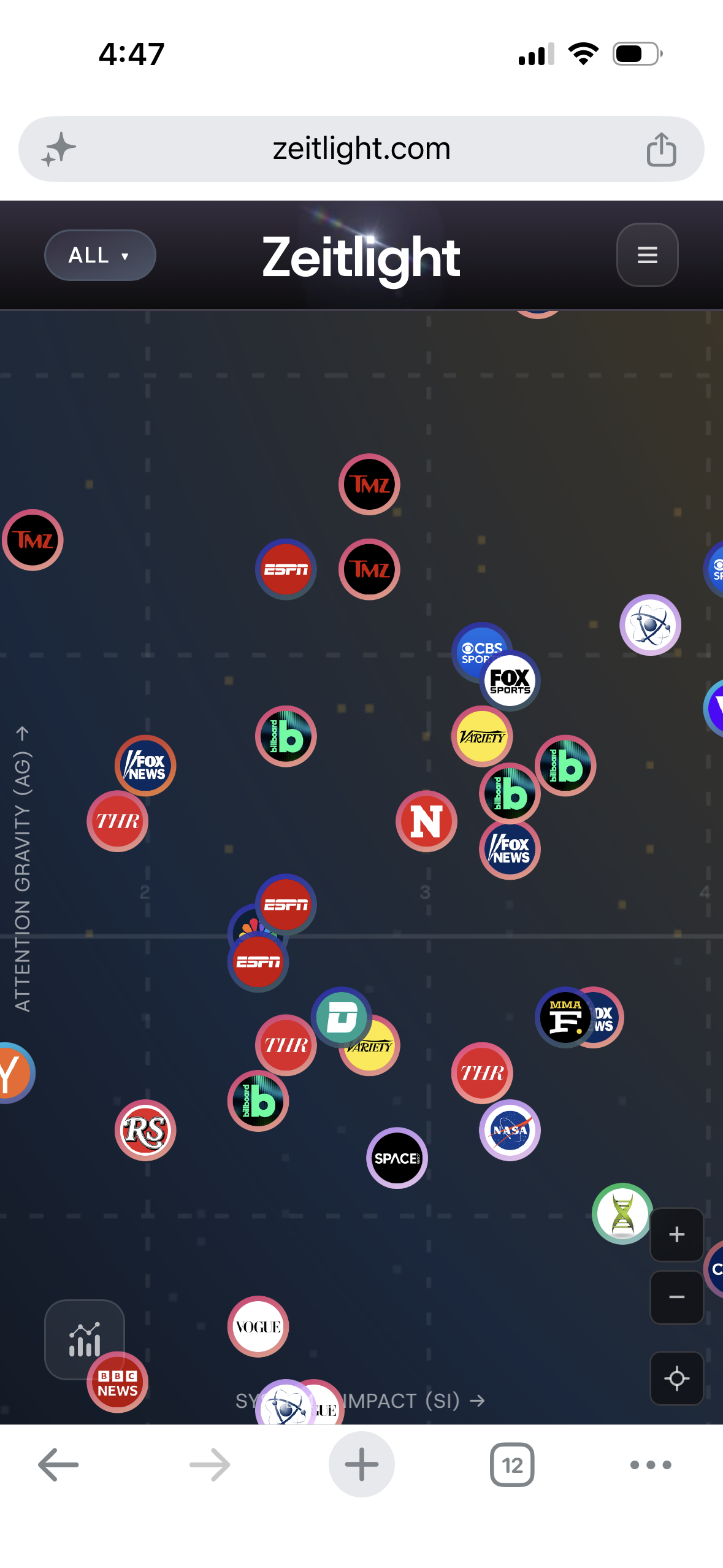
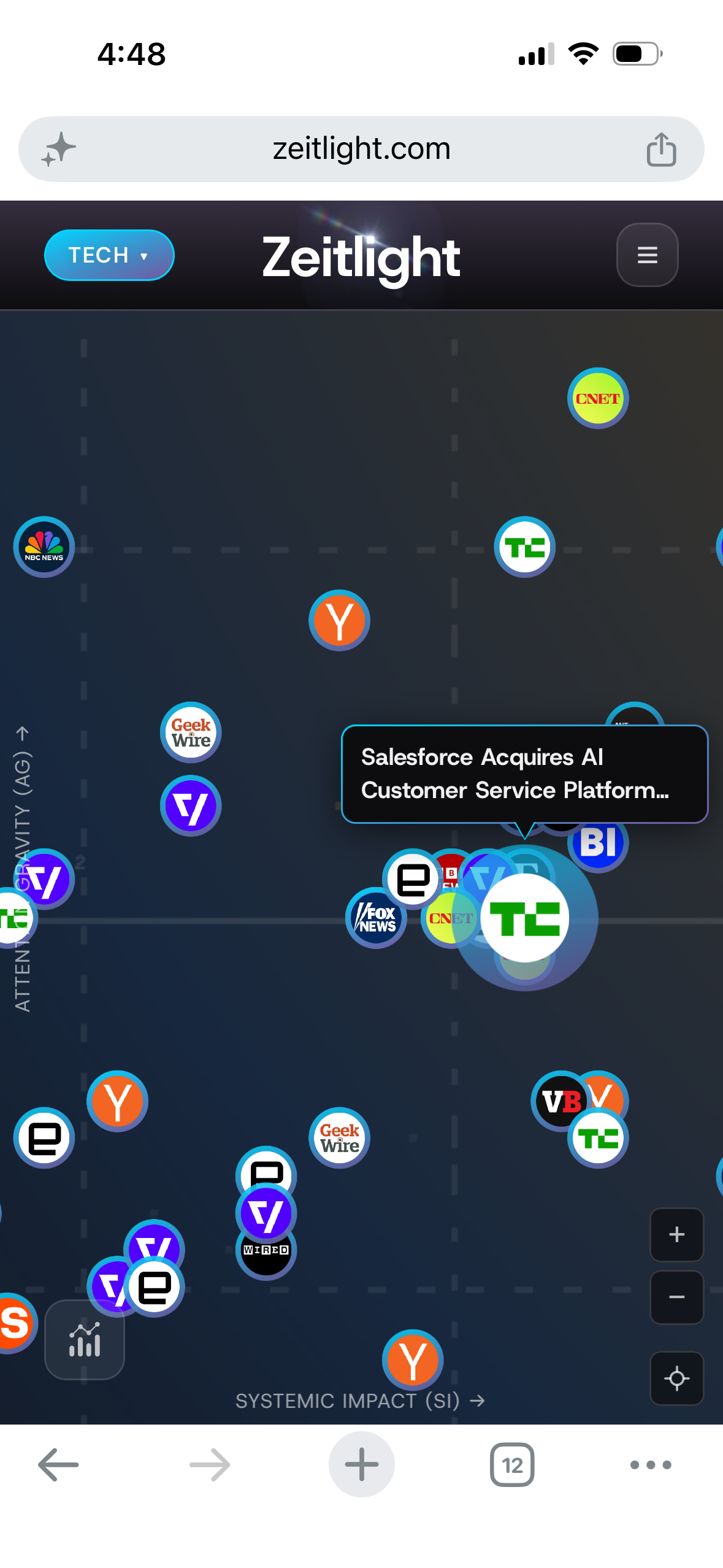
The Quad was designed as Zeitlight’s primary interface: a spatial map that positioned every story according to Attention Gravity and Systemic Impact. To me, it made the underlying model immediately visible. User behavior told a different story.
Analytics showed that people weren’t consistently interacting with individual stories inside the visualization. I added publication logos, hover states, and clearer interaction cues, but testing continued to reveal the same problem: users understood the idea once it was explained, but the interface required too much learning before it became useful.
Original Interface
The Quad
A spatial interface mapped live stories across Attention Gravity and Systemic Impact, allowing the information landscape to be read visually rather than as a conventional feed.
Behavior over assumption.
I had designed the Quad around how I wanted to explore information. Testing made it clear that this wasn’t necessarily how other people wanted to consume it.
Rather than continue adding instructions to an unfamiliar interaction model, I kept the underlying scoring system and redesigned the way users could access it.
Revised Interface
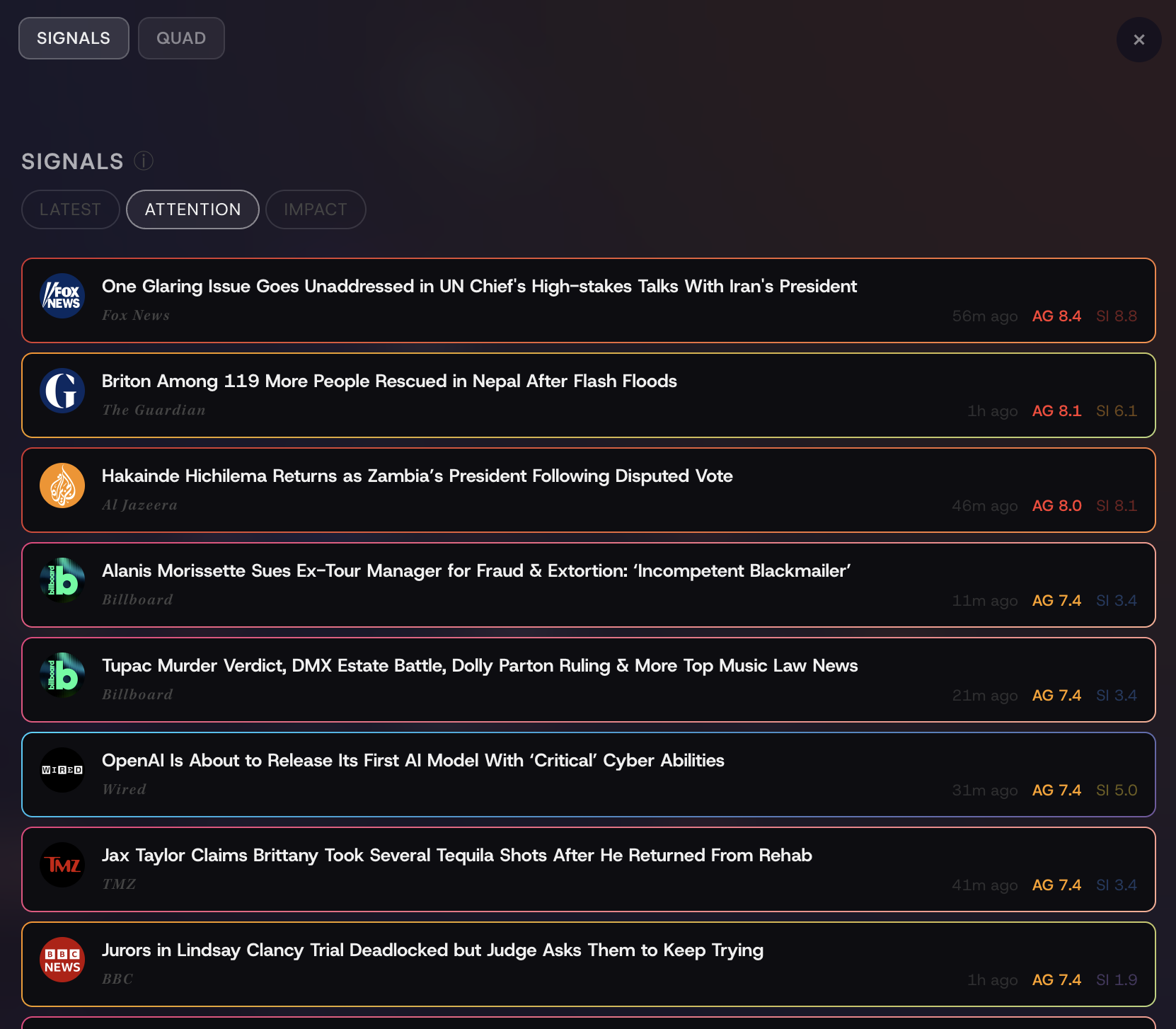
Signals
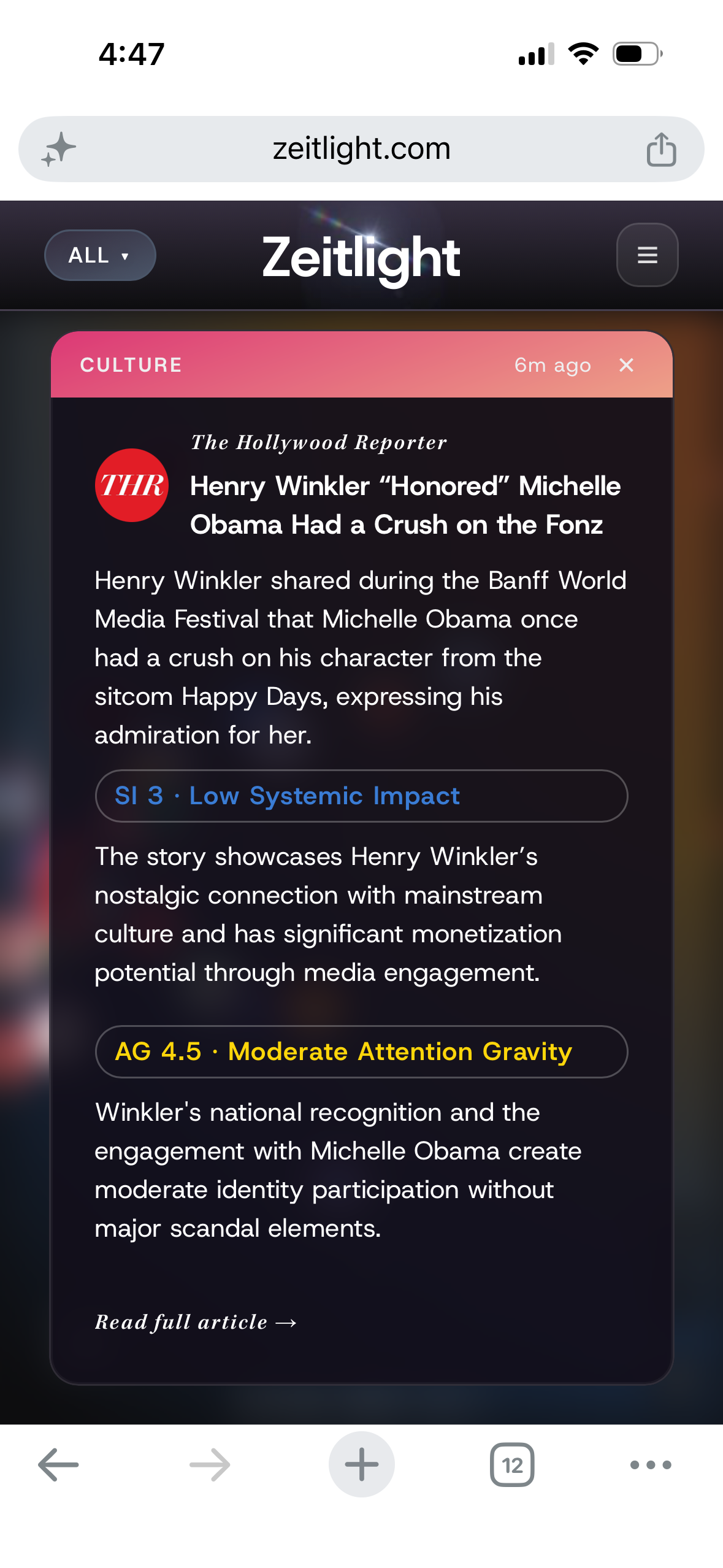
Signals translated the same Attention and Impact data into a familiar linear feed. Users could move between Latest, Attention, and Impact without first learning how to navigate a spatial visualization.
Latest
Newest stories regardless of score.
Attention
Stories creating the strongest attention signal.
Impact
Stories carrying the greatest systemic consequence.
A sophisticated system doesn’t require a sophisticated interaction.
Zeitlight changed how I think about product design. Novelty in the underlying model can be valuable; novelty in the interface has to earn its complexity. When users struggled with the Quad, the answer wasn’t to explain it harder—it was to give them a more familiar way into the same information.
05 — Live System
Built to run without me.
Zeitlight was built as a live product, not a static prototype. Once deployed, the system continuously monitors its source network, identifies new stories, processes them through the classification and scoring pipeline, and publishes the resulting data without manual intervention.
The system remains operational today. As of September 2026, it has processed more than 395,000 real news articles across a source network I configured and maintained.
395,228
Articles Processed
~70
Live Sources
8
Information Categories
~10
Structured Evaluations Per Article
5 min
Automated Ingestion Cycle
System Total · September 2026
Live Data
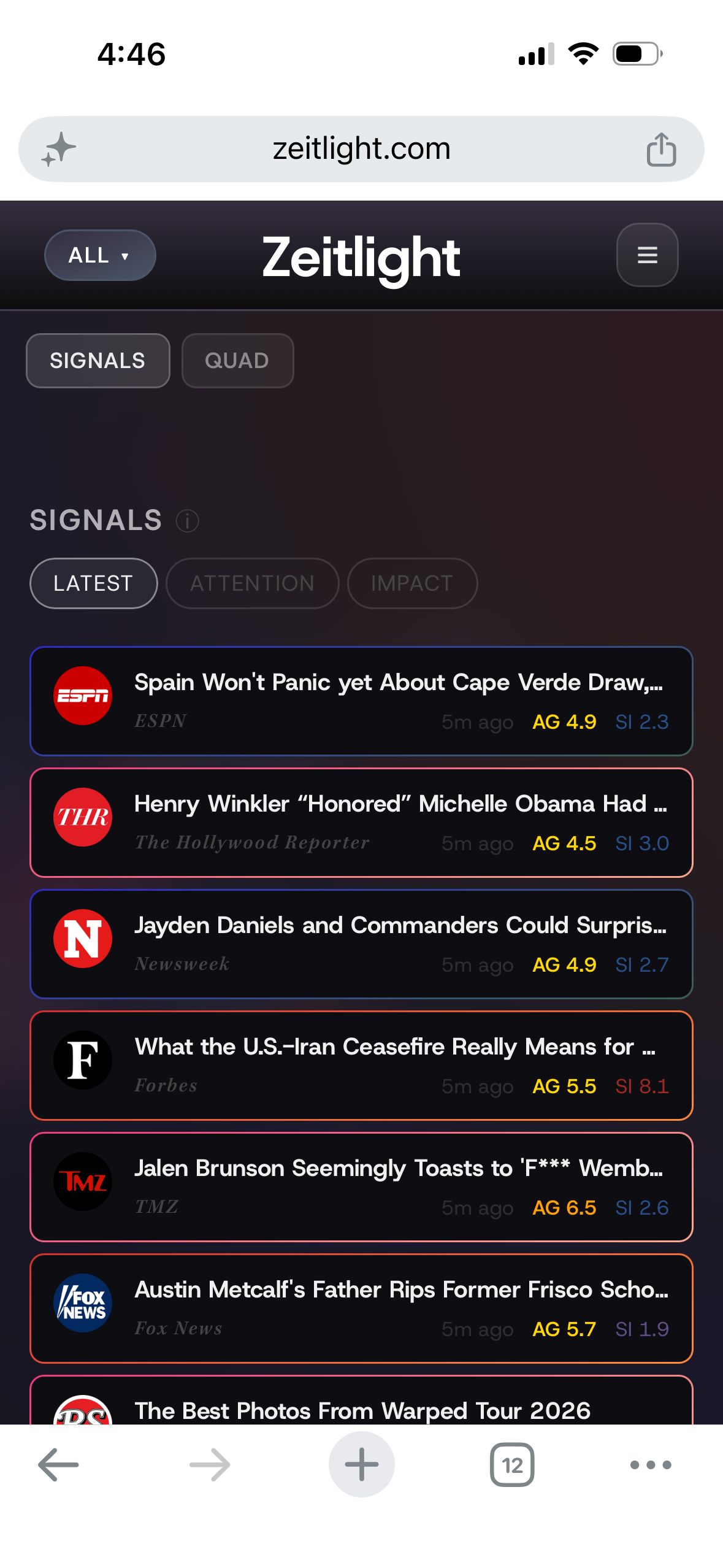
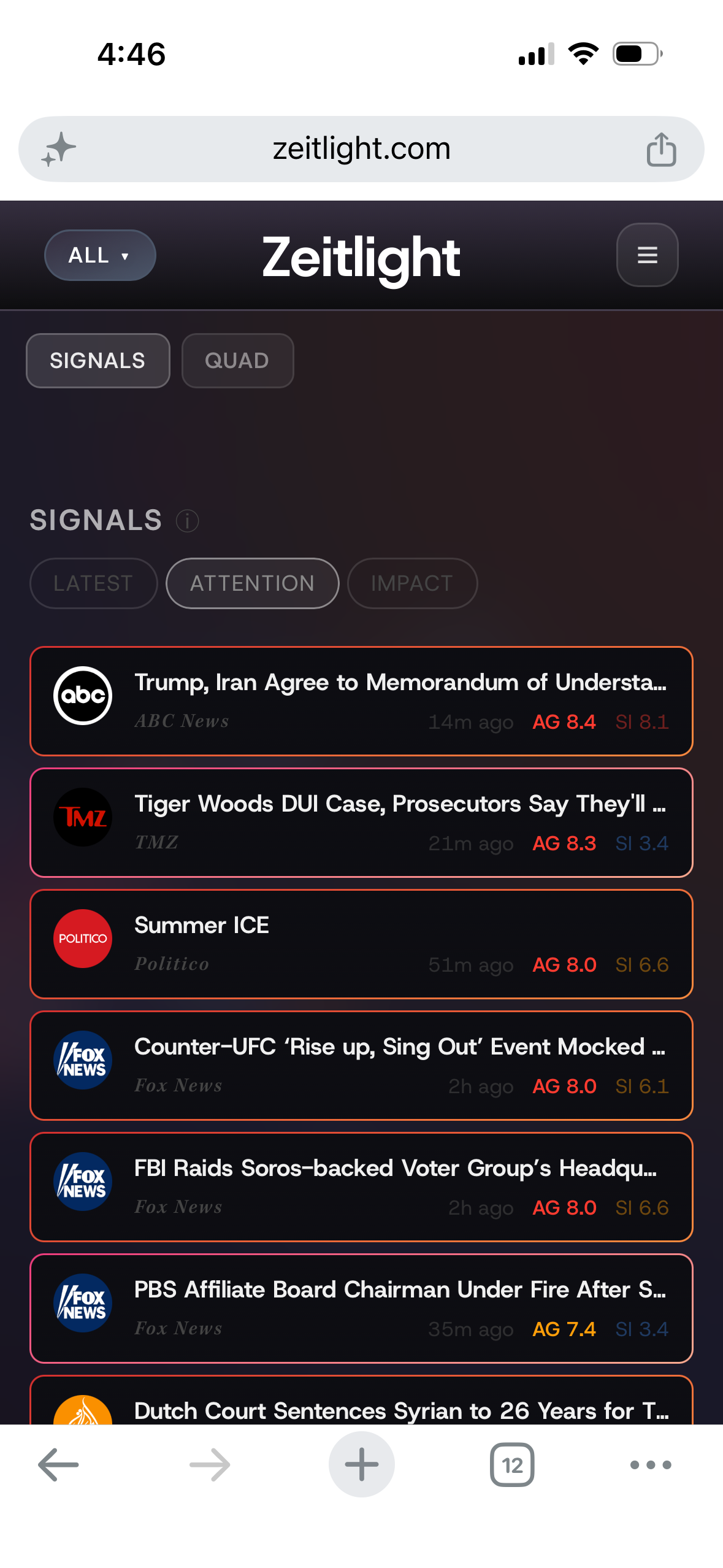
Processing the news as it happens.
Zeitlight operates against current news rather than a fixed demonstration dataset. New articles enter the same pipeline used throughout the project, allowing the scoring system to be evaluated continuously against changing real-world events.
Product Testing
Building in public.
I shared Zeitlight throughout development, recruiting roughly 200 testers through X and another 30 through professional networking and in-person conversations. I regularly exchanged product feedback with other independent builders and used analytics alongside qualitative responses to identify where the experience was working—and where my assumptions were wrong.
That feedback directly influenced the product, including the decision to move beyond the Quad as the primary interface and develop the more familiar Signals experience.
The goal was never simply to demonstrate that the interface could work. It was to build enough of the underlying system that the idea could be tested against real information, real behavior, and real users.
06 — What I Learned
Knowing what to build, and when to stop.
Zeitlight began as an experiment in making news easier to understand and became my first attempt at designing and building a software product from the ground up. In the process, I learned how to translate subjective questions into structured systems, design constrained AI workflows, work with live data, test interfaces against real user behavior, and use AI-assisted development to turn a product architecture into working software.
It also exposed where my process needed to change. I moved too quickly from an idea I believed in to building the system around it. User testing showed that the original Quad required too much explanation, the scoring model still needed continued tuning, and the consumer news market offered limited incentive for users to adopt another standalone product.
Rather than continue expanding the system simply because I could, I stopped active development. The experience changed how I approach new products: validate the problem earlier, introduce unfamiliar ideas through familiar interactions, test the smallest useful version first, and let evidence determine how much complexity a concept has earned.
Before
- Idea
- Design the solution
- Build the system
- Find users
Now
- Problem
- Research
- Test the kernel
- Observe behavior
- Earn the next layer
I started Zeitlight knowing how to conceive and direct complex ideas. I finished it knowing how to architect a working product around one.
Independent Project · 2026
Product Strategy · Brand Identity · UX/UI · Information Architecture · Systems Architecture · AI-Assisted Development · Product Testing